Showing posts with label Settings. Show all posts

Sunday, April 17, 2011

O - Old Cities

I love my hometown. It has its problems, as any city does, but I love it.

Why? Well, when you think about it... I live in a 400-year-old fortress perched on a cliff. What's not to love?

Quebec City from the sky

Granted, I don't live within the fortifications proper, but I am a big walker, and the hour it takes from my home to the Old City doesn't bother me. Especially when I have a friend to talk to, which is most of the time. I walk there and run my fingers along the ancient walls, marvelling as the brittle stone sometimes falls under them.*

The Old Quebec is full of snaking streets, old fortifications, stairs, canons and plaques with names of noteworthy folks that inhabited the houses. You can almost feel history tapping on your shoulder and smiling.

This post is an hommage of sorts, crammed with pictures. I hope you enjoy them!

Entering the Old Quebec -- La porte Saint-Louis
This is one of the two main entrances into the Old Quebec. You can walk atop the wall, too. The view is great.

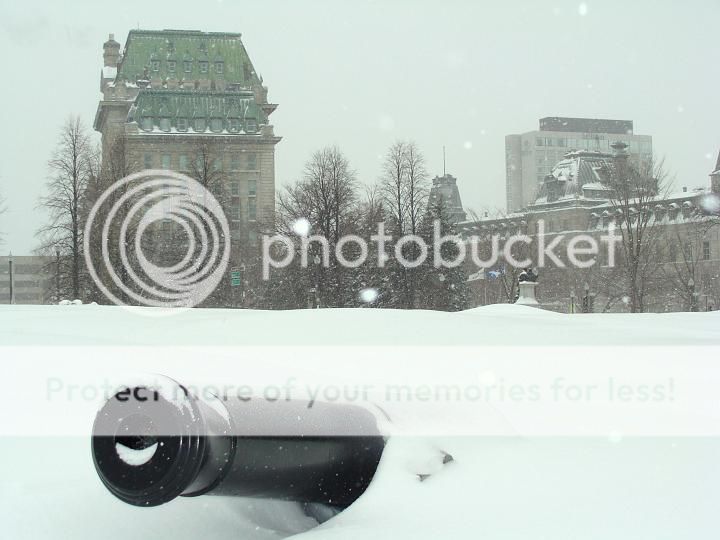
The old canons in winter
 There's nothing I love more than a fresh snow (except, say, the last one we got. On Saturday evening. I mean, really, past mid-April?). It makes everything look prettier. For example...

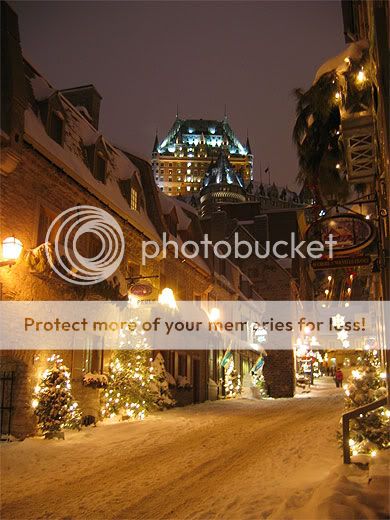
Le Petit Champlain, downtown Old Quebec
Last but not least... anyone remember that scene from Catch Me If You Can, where DiCaprio gets caught, at the end, in a quaint French village? It was filmed at a well-known plaza, here in Quebec. I was so surprised when I saw the movie!

That's the scene. Filmed at Place Royale, not far from the last picture
 So that was it! I could post a lot more, of course, but at some point I have to exercise some control! I love places with a rich history. My hometown is one, and I'm glad about that.

What about you, guys? Any quirks about your hometown you particularly love? 

*Writing this gave rise to yet another underlaying plot idea. My imagination is now running wild with the possibilities. Head? Meet Desk.

Tuesday, March 8, 2011

The Milieu Story

**The ideas here come from Orson Scott Card in How to Write Science Fiction and Fantasy. This is my take on them.**

The milieu story is about the setting. It's the world surrounding your character, the weather, the family, the society, the pantheon. Everything you bring out during world building. These stories are often about travellers stuck in a distant land. Can the character return home safely? Will he choose to live in this new place?

A lot of fantasy is in this category. Any story about a character going through a portal and discovering a wild, strange land is a milieu story. Say hi to Alice in Wonderland, everyone. Unless I'm mistaken, Narnia also falls into this category.

If your main concern is the discovery of a world (through a series of other events, of course), then you are writing a milieu story. Chances are, your POV character is the stranger, who'll experience the wonders of your setting at the same time as your reader.

Other examples given by Orson Scott Cards are Gulliver's Travels and Shogun.

My original ideas for Edingher were of a milieu story. Most of the plotline happened at sea or on a small archipelago, whose culture and magic differed from everything the MC had seen before. There is still some of this discovery plotline in Edingher, but it now serves another type of story.

I'm curious, is anyone writing a milieu story? Can you think of any others?

Thursday, February 10, 2011

Writing and Roleplaying

When I mentionned that my main character was born from a roleplaying game in my last post, a surprising number of you commented that it happened to them on a frequent basis. I used to have trouble accepting the strong influence of the games on some of my work, and the lesser but-no-less-important presence in the others. I came to the craft of writing through roleplaying, but today I can tell what works, and what doesn't.

Characters
This is what I transfer the most from my RPGs. I have created characters I love through the years, with a well-developped and often under-exploited background. It's a truth of gaming (especially online) that half the hooks you build into your backstory will never surface again. I love to explore those subplots. Sometimes they even become the main intrigue.

I find that character personalities translate well from RP to writing. Sometimes, however, changing their abilities and races might serve your story. There is a lot of 'epic' with RP, and I find not all of it fits with my style.

Plots
Perhaps this is only me, but the only plot I have kept from a RP was one that focused on a family's internal relationships. I find that most plot require heavy work to fit the narrative structure. Pluck elements and premises if you like them, but I don't recommend clinging to all scenes or to the way the story evolved.

EDIT: It just occured to me that a lot of the plots I've reused are Character Arcs. It makes sense, considering I mostly import characters.

Setting
While I have changed settings between a story from a RP and the novel form, I think this element can be transfered easily. You need to think about what you want (high or low magic, for example) and what serves the story best. DnD is a mash-up of many mythologies. Take the time to decide what you need, and take the time to check on the original myths, too.

By the way, this is not to say you should dump all orcs and trolls and elves and dwarves. When you write a novel, however, you need to think them through, explain them, and know what makes your setting unique.

I'm sure there is a lot more to be said, and this is a topic I'm likely to revisit. Roleplaying games are an incredible source of inspiration for me, but adapting them comes with a lot of problems. The potential is there, however, and a good writer knows how to tap it.

Thursday, January 13, 2011

Something Is Missing

In the last few days, I've worked more in my novels than I have since the year began. I solved all but one of my last storyline problems. I tied my characters together more fully than ever before. I know their motivations, their goals, their stakes. I know which of them will achieve their goals, which won't.


My plot, too, seems finally good to go. I have all the major landmarks. I have twists, turns, roadblocks. Hopes and despair. It unfolds in an organic way (the second draft did not) and tension builds up all the way through the end (the first draft did not). The scene-by-scene outline is coming together nicely.

And yet, something is missing.

Despite the progress I was making, my excitement diminished. I wasn't fully conscious of it, not until I opened my outline document yesterday and heard myself sigh. Yes, at times writing as felt like work to me. I've had to force my butt in my chair to work. I had to ignore the calling of more entertaining endeavours. But always, when I reminded myself no one would teach me to write - that I had to learn on my own - I was able to stay focused.

More importantly, it was never during the planning phase. 

I asked myself what was wrong. Since when was I not excited at preparing my story? What was WRONG with me? I had this nagging feeling, growing with every day, that this new draft would be missing something important.

I found what when I considered reworking EDINGHER instead. Let WHITE ECHOES rest and light up a new flame, y'know? I kind of miss Edingher's deep and rich setting.

Setting. 

This is what WHITE ECHOES is missing. The setting is getting better, yes, but it still feels generic. It doesn't live and influence my storyline. Not as much as it should, anyway.

Worldbuilding is one of my favourite part of writing fantasy. This WIP isn't fantasy, however, and somehow I forgot to put as much thought and energy into detailing the world as I usually do.

I have a lot of work ahead of me before I start the next draft, even moreso now that I have found my problem. While it makes me sigh, I know I have saved myself a lot of time in editing.

Tuesday, October 19, 2010

Explaining the Technology

I've already discussed how I find it disappointing there aren't more settings that combine magic and technology. It was... right here (yes, I know, not even one month in this blogging thing and I'm already shamelessly linking myself).

Ironic, then, that I am currently working on a setting with a few technological elements... and no magic.

Yes, I know.

It's not what I want to talk about, though. While I worked out the kinks of my world, I came up with a simple problem: explaining why I had different level of technology in the same world. What I mean by that is that I wanted airships next to the old printing press, or large amounts of electricity with communications limited to telegraphs.

My first thought was to explain it through the humans' needs. Why spend time developing technology if it won't serve? That could explain why there was no wire communication along with the airships. But what about the rest? And why on earth would zeppelins still be the main method of travel?

I need reasons. I know I could let some of these things unexplained, since it's unlikely I'll get to say all of this in the novel. But I can't. When I ask myself the Why Question, I need to answer it.

I was stuck, though. Nothing I thought up seemed good enough. What did I do? I called upon a writer friend, of course! Here's what he told me: "Maybe they had a lot of natural gases?"

Maybe I'm the only one who never thought of it that way, but I was amazed. Flabbergasted. Not once did I try to explain it through the resources. It seems simple now, and obvious, but it hadn't crossed my mind. After my friend asked me that question, everything fell into place (you know how fun that is).

I guess the moral in this is simple. When trying to explain the evolution of any society's technology, there are two things to consider: needs and resources. What you want to do, and how you can do it. The formal and material cause. (I know, I know, shameless!)

With that, I return to my worldbuilding. Also... 10 days until NaNoWriMo!

Monday, October 18, 2010

The Setting is in the Details

I haven't been blogging for a long time, but it should be increasingly obvious that I love worldbuilding. There is something magical to imagining a time and place separate from our own, where everything works differently and which has its own, unique culture. I am, and will always be, fascinated thick and complex web of connections that emerges between various spheres (political, cultural, geographical, etc.) as you define your new world.

No matter how much time you spend playing around your world, adding new regions or races, or explaining the cultures in it, however, it will lack a little something called life.

Nothing will bring life in your world like actual writing.

I think it's when you write that the details of your world will emerge. They will evolve from your planning and give concrete shape to what you created. And the best way to make your world shine through without exposition is, I believe, in the details.

Our beliefs and our culture is reflected in how we talk and act in our everyday life. Subtle details spread over the course of an entire novel will have more impact than any exposition, not to mention they won't stilt your story.

Here are a few examples of what I call 'details':

Salutations and warding gestures. Here we wave at each other, or we do the christian crest to ward off ill thoughts (I apologise if that is not the correct term. It is a direct translation, and despite my best attempts, I could not find the 'official' name on the internet). Other worlds with other religions may have different sets of gestures, more related to their beliefs.

Swear words and other expressions. Many English swear words will be related to sex, whether it is direct or indirect. Here in Quebec, they are distortions of church words (and are often called Church Words). Swear words (and any other expressions, really) depend a lot of where you are. If you can come up with one that reflects your culture and could be yelled in a moment of frustration, go with it!

Clothing and architecture patterns. How easily can you identify a historical period by the clothes worn? By the buildings? There have been distinct variations throughout history, and when you research them, you realise there are always cultural reasons behind them. Think of how your society's belief will influence how they build and what they wear. As an example, my expansion-obsessed culture will be wearing ample clothes, with hanging sleeves.

Historical/Religious/Geographical references: There are many terms used in our daily vocabulary that are references to past events or to important figures. Don't be afraid to event some, but make sure they are easily understood. If the first time you use a name, what you are trying to say is obvious, you are establishing a life to your setting outside of this novel. That's good, but do be careful not to make obscure and impossible-to-get references. If they sound like an inside joke, you're doing it wrong.

All of these don't have to be planned in advance. Some can be, but in my case it often comes up naturally, and I write them down in a separate document to keep track. After all, I wouldn't want to confuse two elements, and I like to reuse key details until the reader remembers them!

Wednesday, October 13, 2010

Technology in Fantasy

Most of the fantasy I write is set in a pseudo-medieval setting. Most the fantasy I see published is either pseudo-medieval or urban. While in-between exists, they aren't very common.

So where are the fantasy novels with a decent level of technology? Where are those with prints and guns? Often you will have either magic or technology, but the two shouldn't be exclusive. I don't believe one can completely replace the others. Technology is accessible. It does not require its maker to stay around, or for you to know the details of its creation. Anyone can use a gun. You just pull the trigger.

Print in particular is something I want to use at some point. It changes the way information spreads and how your ruler(s) will communicate with the people. A simple political intrigue can be complexified by print, especially when nosy reporters are trying to get a scoop. Propaganda could become an important aspect of the novel.

We often default to medieval fantasy by force of habit, but when you consider the myriad of possibilities offered by combining your fantasy races and magics with technology, it's a wonder there aren't more of these books out there! There's steampunk, but it's only a fraction of what could be done.

And if you have recommendations, give them! I'll want to know what has been done in the area before I start my next WiP.

Friday, October 8, 2010

The Unexpected Ramifications of your Setting - Part 2

As I said in my last post, there was more than one way in which my setting surprised me with special ramifications and forced me to give more thought to the world I have created. Today is the second part of this small series: fortifications.

First, though, a disclaimer. I am not well-versed in the art of medieval warfare. I have basic knowledge, gathered from years of fantasy reading and from talking with those who do know what they are talking about. It has always been enough to get by in the past, because I have not been writing war-centric novels. So, if I say something stupid, please forgive me (and correct me. I live to learn!)

Now, I don't need to be a pro to figure out why thick and high stone walls are useful against an army. The problem with fortifications is when you decide to factor in magic. In my case, stone-shaping magic.

Suddenly, the castle's impressive walls don't mean so much. Any mage can make a hole in it and let his troops in. Or he could dig a tunnel and send a small team to strike at the enemy army's head. 

In such a world, tacticians would've elaborated defenses to counter the magic and make forts effective. There's no way around it: it doesn't make sense to keep your fortifications exactly the same as during the Middle Ages.

I am still going through my options to counter this. Since I have two fighting faction, one which can shape wood while the other has power over stone, I may build fortifications with a thick layer of wood behind the stone walls. Small frontier villages might be up in the trees, with the cultivated fields below. The details aren't clear yet.

What I do know, however, is that magic changes the art of war, and that if I want my world to be credible, I cannot ignore the new possibilities.

Wednesday, October 6, 2010

The Unexpected Ramifications of your Setting - Part 1

When you start worldbuilding, it's hard to grasp all the consequences of the decisions you make. You have an idea of what you want, and what's different about this world, but your picture is still rather blurry. You don't know the details yet, and you can barely make out the shapes. And sometimes, when you look more closely at one element, you get a surprise.

As this happened to me twice in the past week, with totally different aspects of my world, I figured I should (read, totally wanted to) share them here. It was getting a bit long, though, so here is the first part:  

Beauty Standards

I was working on one of my characters and trying to define her better, both personality-wise and appearance-wise. I knew she was young-ish (16-17), reasonable, that she had sharp wits and that she knew how to deal with a court, or mostly. She still had a fair layer of naivete, but she was the kind of woman you could get along with easily. So I guess I was more trying to define her appearance-wise after all!

Anyway, I went on thinking I wanted her to be rather nice looking (no, I swear, she's not perfect, but that's not what I want to talk about here).

And here's the catch. Nice looking. Beautiful. What does that mean?

We know what it means today, in our world. We know the most common beauty standards. We like our women thin, with nice breasts and full lips, shaved and shapely legs, and smooth, silky skin. We like our men to be muscled, with a firm ass and a great smile. Among other things.

In a fantasy world, it doesn't have to be the same. It can be, and that's all good. Except there are times where it would make more sense for it not to be.

In my case, this lady is from a culture that obsesses about expansion. They spent years warring. They wear large and ample clothes, with sleeves hanging down low. They like their cities to span on a lot of ground without being high. And I think they should like their women with some fat on.

There are cultures on Earth in which fat is connected to wealth (with good reasons) and this also makes sense in this world. Nobles can afford it and while the ladies will want to keep slim enough to be graceful, they definitely won't be all skin on a stick. And the men, once they grow too old to fight, will acquire a belly. Here, fat will be a good thing, not a bad one, because it is, in a way, a physical expansion.

Tuesday, September 28, 2010

Common fantasy assumptions

In my few years of writing, I have always written novels that took place in worlds different than Earth. Sometimes these world were filled with magic. Sometimes there was nearly none. Sometimes there were elves and dwarves and gnomes; at others all you could find were humans of different nations. None of my settings are the same, and none of them give quite the same vibe either. Fantasy worlds have the power to be anything. When you throw the first bases, your imagination is the limit.

And yet, there are certain things common to all fantasy settings (or nearly) and that do not have to be.

Sometimes last week, Ted Cross posted on his blog about how most fantasy settings were north-hemisphere centric. He also noted in the comments that we tend to put the ocean on the west side of our continents. Fantasy writers do these without even thinking about it. I sure did, and more than once!

These can be explained by the fact fantasy settings are often similar to medieval Europe, but there are other aspects of fantasy we include almost without noticing. About a year ago, I decided to go after one that irritated me.

Magical powers are discovered at puberty.

Harry Potter has this. Eragon has this. Nearly every YA fantasy in existence has this! But I don't think it's YA exclusive. So many things happen to a teenager at that age, it's only natural to throw magic in the lot.

Well, no more. For a year now, I have been working on a setting where magic is associated with old age, because it arrives at about the same time menopause/andropause would. It's associated with loss of fertility, among other things, and I have tried to rethink a lot of my fantasy assumptions around this new fact.

It's important to understand my story isn't about magic being restricted to old people. It's something else entirely. But this is an important shift in how magic functions, and in certain parts of my world, it has a great influence. It is as much part of my world  than the religions, the kingdoms and the geography.

So let me ask you... are there any common fantasy assumptions you break?