Showing posts with label geek. Show all posts

Monday, September 12, 2011

Gummy Embyo and Other Transparent Organs

Biologists have long relied on dissections to study the body and organ structures of different animals. We've all had that class where we cut up a bull's eye, a frog, a mouse or a fish. Sometimes all of these.

We've also used specific species to study the embryo's development, such as the zebra fish, which has the awesome particularity of being transparent at that stage, and which we engineered to remain transparent all the way to adulthood.

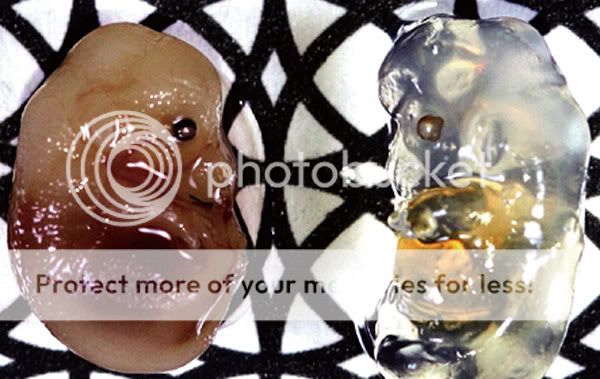
A team of Japan scientists just discovered another, madder way to study organs. They developped a chemical reagent, Scale, which turns biological tissue transparent.

Image courtesy of io9, very awesome science site


Those are two mice embryo. The one on the right was treated with Scale, and now you can see everything inside. 

Scale and Optical Imaging Techniques

The beauty of Scale isn't only that it can turn tissue transparent. It also does so without interfering with the fluorescent dye commonly used today in our best imagery techniques (these are very awesome, and I spoke about them in my three posts regarding the brainbow here, here and there).

This means scientists are able to colour specific tissues with a fluorescent protein and use the transparency reagent to remove all interferences. This gives them images of unprecedented clarity. The Japanese team used it to study the mouse's brain, but it is applicable to just every tissue under the sun.

What Remains to be Done

Scale currently has one big disadvantage: it's too potent to use on living organisms. Dr. Atsushi Miyawaki, the leading scientist on the japanese team, believes this could change. They're currently working on a "another, milder candidate reagent which would allow us to study live tissue in the same way, at somewhat lower levels of transparency."

If you want to know more, you can read the io9 article on the subject. I have to agree with them: the transparent embryo looks like a gummi. Yum! 

Monday, August 22, 2011

The Immortal Jellyfish

Nature is full of surprises and crazy exploits. Some are pretty and fascinating. Others are mindblowing.

Turritopsis nutricula is one of them.


This medusa is smaller than your fingertip, but you can bet it'll live on longer than you. In fact, barring environmental predators, it'll never die. That's right. Our friend T. nutricula is an immortal jellyfish.

Turritopsis nutricula uses a nice and simple (in appearance, anyway) trick to achieve this: it inverses its life cycle as it gets old. This jellyfish developped a special process that allows it, through the use of unique cell tissues, to reverse its aging and return to polyp form.

If you've watched The Curious Case of Benjamin Button, you know what I'm talking about. Imagine if we could from baby to old, then back to baby, forever and ever.

Crazy. Also, great fodder for far-off science-fiction or a magical race. But that's my writer brain talking.

It's a good thing T. nutricula isn't a four-feet large jellyfish, otherwise we'd have a Worldwide Giant Medusa Invasion on our hands. Meep!

Friday, August 12, 2011

The Penicillin of Viruses

You know what can turn an oh-my-god-can't-write-to-save-my-life day into a fairly nice one? Good Science News. Promising discoveries! Hope for our Cure-The-Sickness related future!

That's what happened when I found this article on MIT news. A team of researcher from the MIT Lincoln's laboratory developped a new drug that can identify cells infected by virus and terminate them. And that, my friend, is full of awesome.

The Problem with Treating Viruses

Viruses have this badass and terrifying strategy in which they infect the host's cells, hijack their resources and begin to multiply. The cell does have a few defenses to prevent this, but most viruses have found ways to bypass and counter these. Otherwise they wouldn't, you know, still exist.

The point is that once the virus is inside the host cell, it becomes difficult to distinguish from the non-infected cells. We manage to develop specific drugs for specific viruses by hindering their unique ways to act, but viruses have such a vast array of techniques and molecules that it is almost impossible to produce one drug that affects them all.

That is what the MIT's lab achieved. One drug for most viruses.

How the hell?

OK. This is the science part. Let's try and keep it simple. Every cell has DNA, on which we have carry genetic information. In order to access that information, we create an RNA molecule (think of it as a close-cousin of DNA) from the DNA, which is then read and transformed into a protein.

DNA is double-stranded in humans -- you've all seen the double helix image. RNA, however, is single stranded. Just one long string that twists.

Basic human scheme:  Double stranded DNA --> Single stranded RNA --> Protein

Here are the key points.
1. There is never any double stranded RNA in the human process.
2. There is almost always double stranded RNA in the viral duplication.

Todd Rider's drug identifies cells with double-stranded RNA inside them and hits their self-destruct button.*

 Magic!

And you know the best thing about this drug? It's called DRACO. Not just for fun. The acronym means something. It is also badass.

They tested the drug against influenza (your day-to-day cold) and dengue fever (a cousin of Ebola), and it worked. These are two very very very different viruses. At the moment they're trying DRACO on other viruses in mice before moving to bigger animals, and eventually humans. So it's not ready or finished yet, but one can hope.

And for those of you who want to see more of the science, the drug's action mecanism is explained in more details in the article. Plus pictures of their tests. It's neat!

*Yes, there is such a thing in cells. It's one of the most broken mecanism of cancer cells. Self-destruct buttons: not as useless as in sci-fi movies.

Wednesday, July 20, 2011

Six Thousand Feet in the Air

Chose promise, chose due.

 I promised to tell you all about my hot air balloon trip, and this is where it happens. This post is going to be long and full of pictures. You have been warned!

My first flight plan was cancelled due to bad weather. You don't fly if it's raining, or if the ground is wet. It'd be possible, but it takes more heat to rise, since water makes the balloon heavier. Plus, the view from the sky isn't as clear, and it's nowhere near as cool. So, we waited for the sun and a call from our trusted pilot.

The sun, it seems, decided to come one Saturday morning... at 5:30 am. Which means I was up at 4 am, a feat in and of itself! Honestly, though, I'd been semi-awake since 2 am, alternating between proper sleep and eyes-wide-open-with-excitement. Balloon Ride, my kid mind said. Proper research! my writer mind added. Happy times were to be had today.

So we got up, went there, and then moved with the four other passengers, the pilot and the rest of the crew to our take-off site. They took out the basket there, tied the enveloppe to it and only then did they begin to remove the enveloppe from its bag.

IT IS FREAKIN' HUGE!!
There it was. My first writerly heart attack.

When you read that something is X feet tall and X feet wide, you think "Wow, that's big."  But "big" isn't a concrete measure, and in my mind at least, it doesn't really click until I've seen it. Just like it's one thing to know the Eiffel Tower is tall, another to stand underneath it and look up. Or one thing to be told that northern lights are pretty, and another to see them. Some concepts are too abstracts to grasp with a solid exemple. Hot air balloon bigginess is one.

So we weren't in the sky yet and I already had one small plot problem to solve. But I took heart: that's why I'd come (in addition to the 'having fun' part).

Besides, I wasn't going to dwell on it. Not when they asked for volunteers to hold the enveloppe's mouth open!

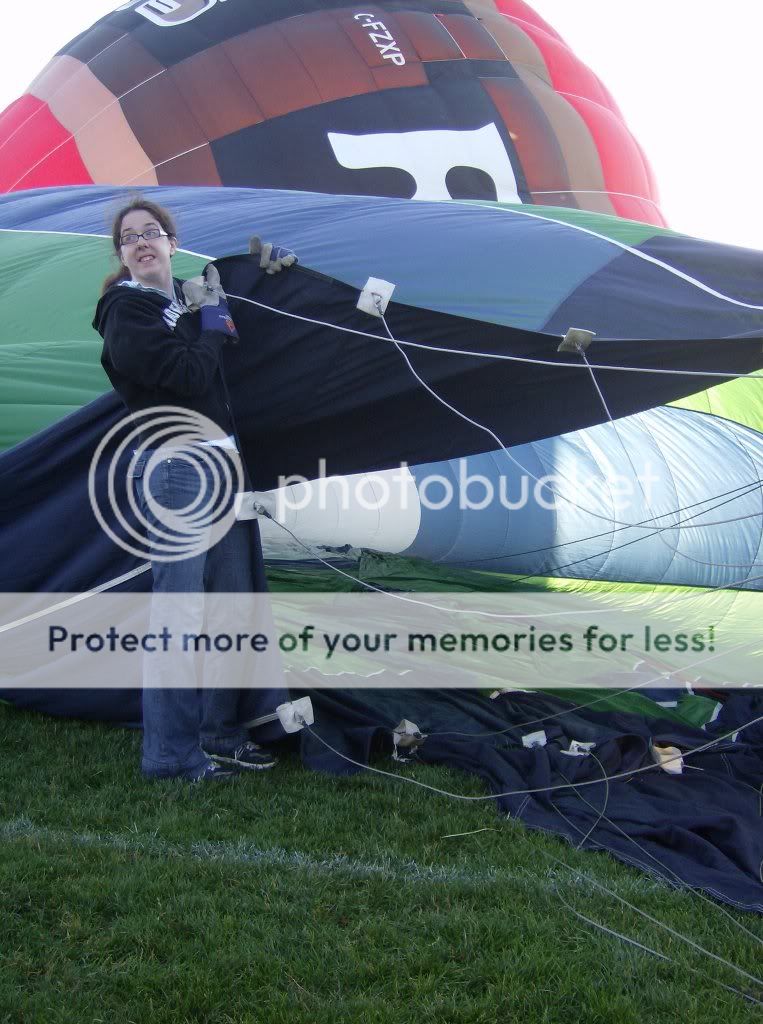
Me with a crazy face, holding the enveloppe

So now I know how it strains the arms to hold it, how freaking complicated it'd be to take off alone, how hot the air gets once they use the burners to warm it (that's why the gloves) and about how long it takes. And yep, that's another balloon preparing for take-off behind us. We were three that morning.

Unlike the enveloppe, the basket was a bit smaller than expected. We weren't squeezed inside, but any tighter and it would no longer have been comfortable. But it was comfy. Also, you don't feel a thing when you take off. You're talking and enjoying yourself, and suddenly the world lowers and you wonder why. Then you look down and see this:

That's the third balloon. It was quite smaller
Once you're in the air, the entire world shushes down. Well, okay, not for the first half hour of the flight, because I kept asking questions to the pilot. "What's that rope?" "And that big red one?" "How does it feel when you go higher? In winter? In bad weather?" "How much propane do you need?"*

Once I shut up, though... complete quiet. Nothing but the soft whistling of gas heading to the burner, and the occasional WHOOOSH when he pushed the buttons. No cars, no birds, no people. Only you, the sky and the world, 6000 feet below.

Now, enough talking and more showing. This is what it looked like from above:

That's Quebec City on the other side of the St-Lawrence River

FWOOOOSH!
I call it the Brocoli Forest
We're at 3000 ft now. Nope, they did not crash in the river
Despite the fact that my mind kept wondering how I was going to fix my newly found plot problems, this hot air balloon trip is one of the most relaxing experiences I've ever had. It's an instant slow down. More than anything I've done in vacation, it took me out of my speedy-speed life and allowed me to take a breather.

The landing was super smooth too, and we shared champagne with the crew and the farmer whose field we'd used as a landing ground.

That's my pilot, in his super cool hat. He's awesome, funny and talkative.
My plot problems are now fixed, thanks to the boyfriend's many thoughtful suggestions and all I've learned on the trip. It's turned a cool scene into an absolutely epic one, and added a new storyline branch to the novel. The balloon trip was a great experience, both for the novel and for the pure awesomeness of it.

Oh, and just in case you'd consider flying around Quebec City or Montreal, my pilot is Jacques Brouard. He has his own little enterprise called Québec Montgolfière and has been flying for more than 20 years now. I recommend him. Seriously.

That's the little story of my brief time in a balloon. You can ask all the questions you want in the comments if there's something you wanted to know, and that I forgot to say. :)


*The last one is super important, considering propane is a rarity in my world.
Thursday, June 23, 2011

Internet Ripples and Geek Astrology

Our wild talk of alcohol must have crossed the internet, because it was the topic of xkcd's comic today. More or less. Here it is, because it's downright funny:


Ever wondered what your geek astrology sign would be? Undead, wizard, superhero, treasure hunter? It's time to find out!

I'm a pirate. I wouldn't be half as pleased as I am if, upon seeing the image for pirates, I hadn't immediately recognised Guybrush Threepwood. Of all the famous pirates out there, they picked my favourite! Whee, Monkey Island.

Don't forget, I'm at Wicked & Tricksy today, with a post on dialogue!

Friday, June 3, 2011

My Microscopic Soulmate

I always thought I was a big coffee drinker. I've drank so much of it in the last five years that I can now spend a whole evening drinking it non-stop and still fall asleep at regular hours (regular for me, mind you). At times, like many friends in a similar position, I have joked that I could live on caffeine.

Little did I know, my caffeine consumption is a real joke compared to Pseudomonas Putida CBB5.

Like Watching a Fire


Pseudomonas putida  is a soil bacteria strain that was recently discovered on an University Campus. It has the epic capability of breaking down the caffeine molecule - which is made of carbon, nitrogen, oxygene and hydrogen, the four fundamental organic elements - into dioxide carbon and ammonia. And when it does that? It creates energy.

As humans, when we process caffeine, we break it down into useless part and excrete it through urine. We don't create energy from caffeine (the boost your getting is the molecule's influence on other parts of your system, not actual energy).

This little bugger can live on a caffeine-only diet. It doesn't need anything else to survive, and will thrive in a highly-caffeinated petri dish. We had the dowright scary flesh-eating bacteria. Now we also have the epic caffeine-eating bacteria.

So to Ryan Summers and his team, thank you for discovering my microscopic soulmate.* Now when I drink over 30 oz of coffee over the span of a few hours, I know that on university campuses all over the world, thousands of billions of Pseudomonas putida** CBB5 are doing the same.

*For the record this research has an actual point. The enzyme could be used in treating heart arrhythmias or asthma, or to boost blood flow. They could also help clear out excess caffeine from the process creating decaf coffee.

**I have no actual idea of how common this strain is.

***I like asterixes. I'm also unsure that's their English name (educate me, dear readers!)

Friday, May 27, 2011

Rosalind Franklin and the DNA discovery

Ladies and gents, I present to you, Rosalind Franklin:

This lady here is a british biophysicist, most known for her work in x-ray crystallography. She was a specialist in the field, and had successfully obtained what was qualified by another scientist, J. D. Bernal, as "amongst the most beautiful x-ray photographs of any substance ever taken".

I'm not discussing Franklin only because she was a good at x-rays, though in itself it's quite an achievement. Franklin had a great deal to do with the discovery of DNA structure, because she managed to take this picture:

Photograph 51
This, to a crystallograph, reads as "double helix". Apparently it's super obvious. I don't know. I'm no crystallograph.

What I do know was that this picture, one of the key elements leading to the discovery of DNA structure by Crick and Watson, was taken by Franklin's colleague and showed it, without her permission, to Crick and Watson.

They built their model based on this x-ray photograph, in addition to everything else they knew. Most think they couldn't have done it without Franklin's photo -- at least not so fast, which means they might not have been the first.

Now, not to remove the credit from Watson and Crick. They put together many pieces of a complex puzzle and came out with the right answer. That's an incredible achievement.

When they published their structure in 1953, however, the only mention of Franklin's work was as a footnote. Ten years later, Watson published a memoir recounting his discovery of DNA structure, The Double Helix. He discredited Rosalind Franklin on every occasion, calling her 'Rosy' and burying her contributions under allegations that she couldn't interpret her own data.

Crick, Watson and Wilkins received a Nobel Prize in 1962 for their work on DNA and other nucleid acids.

Franklin died in 1958, at 37, due to the consequence of x-ray exposure (turns out, x-rays are like radium in this regard).

The rules of Nobel Prizes forbid posthumous nominations. Her name isn't on it, and will never be.

Thankfully, her story is becoming more widely known, and she is increasingly frequently included in the tales behind the discovery of DNA structure, perhaps one of the biggest scientific discovery of our times.


Tuesday, May 24, 2011

Coming Soon: The History Behind the Science

There are a great deal of women who were important to the history of science, and who were either purposefully erased from the records, simply forgotten, or had to go under a man's name for publication.

The truth is, when it comes to science, there's one thing I like more than the science itself... and that's the history behind it. Most important discoveries have a cool story behind them, and some are even a case of intense backstabbing -- as good as any political intrigue, if you ask me!

As inspired by this recent xkcd comic (the same Sommer posted at Tell Great Stories, for those who hang out at both blogs), I'll try to dig out some cool science discoveries for you. It might look something like the post on Osamu Shimomura, and the bit on how close he was to Nagasaki.

If you have any suggestions for these, especially if they are oft-forgotten women, please e-mail them to me at claudiea.writer AT gmail.com  I have a few topics lined up, but I want this to run as long as I can make it.

Starting Friday, with Rosalind Franklin and the discovery of DNA.

Sunday, May 15, 2011

A Giant KAPOW!

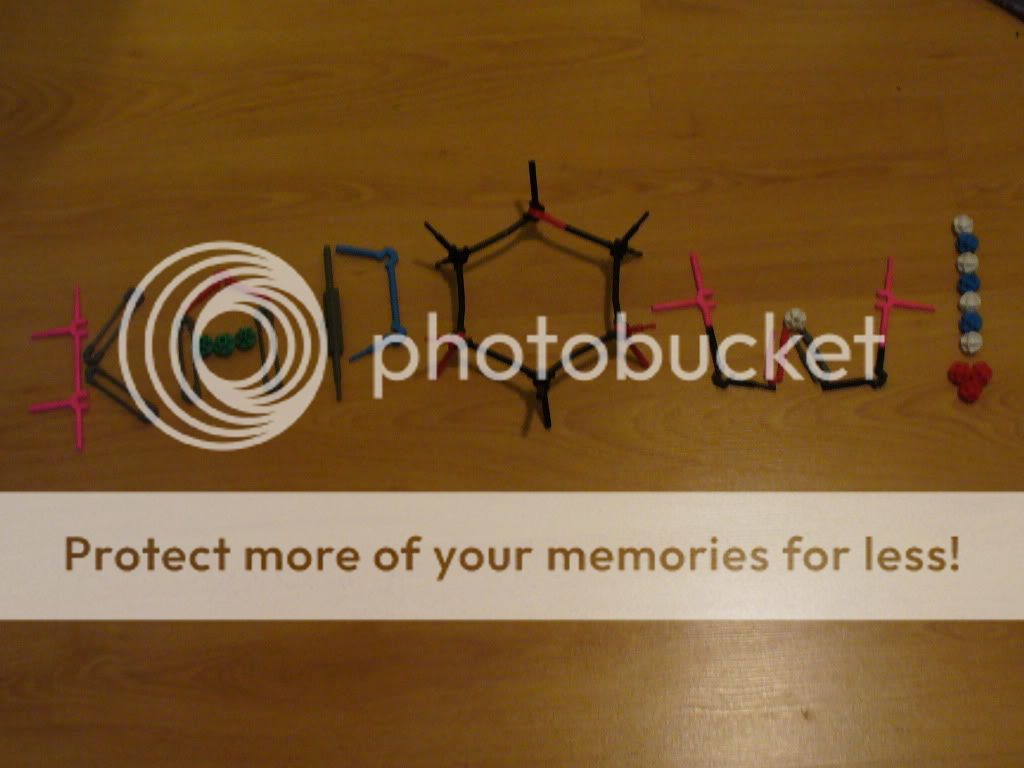
Molecular models for the win!

I hope you backed up your lives, ladies and gentleman, as today might be the end of us all.

May 12th. A plague unleashed upon us all. A young boy, trading a corndog for a spaceship, shooting into space and blowing up the universe. Be ready for it!

It's time to party! 

May 12th is the release date of Jacob Wonderbar and the Giant Space Kapow, by the most awesome Nathan Bransford, whose blog and forums I've squatted for months now. Did I say he is awesome? Oh yes, I said he was awesome.

In honour of this launch, here is one explosive mix: Alkali Metals and Water!


P.S: Thursday is my post day at Wicked & Tricksy! Come check it out, if you dare.

Friday, May 13, 2011

The Brainbow!

This is the third post of a three-part series on fluorescent proteins and neurobiology. The first part is on Osamu Shimomura and the second on the mutations made in the proteins (shiny pictures included).

Today? Today is... the BRAINBOW!

Brainbow image of hippocampal neurons. Courtesy of Jeff Lichtman/Harvard University

This, my friend, is what your brain looks like. Or, well, what it would look like if we used the fluorescent proteins in it.

You remember how last Tuesday I explained they could add a fluorescent protein to any other, making it easy to detect? And you remember the various colours created through genetic mutations? (If you don't, link at the top.)

Well, the Brainbow is perhaps the most spectacular use of this technique. Each individual neuron expresses a different amount of the red, blue and green mutants of the original GFP. Because the mix is not the same in each neuron, the resulting colour varies with every single neuron.

You can see, the result is striking. Since the technique was developped in 2007, multiple pictures were taken, some winning scientific images awards.

So here are some others, for your enjoyment!

Brainbow image of the dentate gyrus. Courtesy of Jeff Lichtman/Harvard University

  
Confocal microscopy by Tamily A. Weissman


I don't know for you, guys, but at this point I just call this art. Brainbow pictures give me an instant geekgasm. Neurons! With colours! Not to mention, this highlights the amazing complexity of our brains, and how much we've yet to learn about ourselves.

Kudos to the scientists working tirelessly on it. I'm too busy staring at the pretty picture!

Tuesday, May 10, 2011

Fluorescent Proteins Part 2: Genetic Manipulations

This is the second post of a three-part series on fluorescent proteins and neurobiology. The first part is on Osamu Shimomura and the third will be on... the Brainbow! I really can't wait to get to the brainbow. 

So, our good friend Osamu Shimomura discovered green fluorescent protein in a tiny jellyfish. Cool, right? But what the hell can they do with this?

In 1962, not much. When genetic engineer techniques evolved and became viable researched tools in the 1980s, the possibilities became endless many.

The awesome thing with GFP is that you can attach it to other proteins. You just put the gene for it next to the other protein's gene, and when the cell produces the protein, it has a GFP attached to it. It's like magic, only it's real!

Proving the GFP could be attached and expressed by cells was made at Martin Chalfie's lab, the second recipient of the 2008 Nobel prize.

What they do with these proteins is that they attach it to another, then they send light of a particular wavelength on it. It absorbs, and gives back light at a different wavelength. It's not hard to detect that light, and the images we get are better with every passing year.

They modified the GFP to give it a wide range of colours and make it easier to insert. This work was made at Roger Tsien's laboratory. Tsien is the third recipient of the 2008 Nobel prize. He created mutants that were stable and produced a lot of fluorescence.

Pretty colours!

Then he and his lab had fun, put the proteins in bacteria and... created a beach!


That, my friends, is science at its best. Crazy and pretty!

Thursday, April 28, 2011

X Marks the Spot - Geocaching


Remember when we were kids and organised complex treasure hunting activities in our yard? I'd gather friends and give them a clue, which would lead to another clue, then another, and on until they reached the prize. So much fun!

Then we grow old, and more important things take precedence to the games. What kind of responsible adult goes treasure hunting nowadays?

The kind who geocaches.

Geocaching is a modern-day treasure hunting which occurs as we speak, all over the world, by tourists, businessmen, locals, serious adults and kids. Anyone and everyone! The idea is simple.

One person hides a cache – a sealed plastic container with a notebook and a pen – in an accessible area, whether  in nature or in town, and puts the GPS coordinates on the official websites.  Other geocachers pick the coordinates and set out for the location with their GPS receptor.  When they find the cache, they put their names in the log and replace it.

Yes, you need a GPS.  Once you have one, however, geocaching is 100% free.  And 200% fun. It's the perfect way to spice up your travel and discover local spots no tourist guide talks about.

Wherever you are or go, it's likely there's a cache nearby. Try it out. Seek a cache with your address and watch a special google map tell you where the hidden treasure is.

And if you own a GPS, why not register and set out for a new, modern-day treasure hunting?

I promise you, it can only be fun.

Anyone else here geocaches? And if you don't, any good memories of a childhood treasure hunt?

Tuesday, April 19, 2011

P - Project Aether

I have a thing for hot air balloons. It's not a coincidence they are a major part of my current WiP. I think balloons are awesome, cute and romantic.

So when my boyfriend linked me to Project Aether and their youtube video, I had a bit of a geekgasm.

These people basically launch a high-altitude balloon equipped with a HD camera. And by 'high altitude', I mean SPACE. The images they filmed are incredible. Beautiful. Powerful.


Yes, the video is 11 minutes. It shows the balloon flying up. Waaay up. Let it load in the background and skip parts if you must, but watch it. Oh, and use Full Screen Mode for full effect. It's worth it.

Enjoy the ride!

Tuesday, April 12, 2011

J - Jigglypuff Would Make a Great Writer


Nothing stops Jigglypuff from practicing his art. He travels around the world and sings, whether you like it or not. It doesn't matter how often you tell him to stop because you'll fall asleep he will not let anyone stop him.

There's two things for writers to learn here: always persevere and believe in yourself.

But please, don't answer the critiques the same way he does:

Watch your faces!
Happy Tuesday!

I think that's as geek as I've ever gotten on this blog. It may happen again. You are warned.

Tuesday, March 1, 2011

Amazing Zelda FanArt

Today I am afraid I shall geek out on you, and share the most amazing fanart I've seen. This isn't the piece proper, but rather the youtube video of its Making Of.


Watch it, even if it's just parts. I have spent the last 15 minutes gaping at my screen.