It's blogfest season! Don't tell me there's no such things. There is no other way to explain the pile (read three) of new and awesome blogfests coming our way. One of which is mine. Yeah.
Anyway, here they are:
The I AM LEGEND blogfest
My blog isn't the only one who's nearing its one-year anniversary. I stopped counting how often I linked to Urban Psychopomp, but there you go. Once more! In her own words:
"The idea behind the blogfest is to give people an opportunity to share what is EPIC LEGEND WIN about their WIP or their favorite book. Is it a larger than life mythical creature? Is it a hero possessing such tenacity that he puts all other heroes to shame? Is it a war of such devastation that the human psyche will never be the same?"
This is going to be fun. There is Epic in all of our stories, and it's time to get it out. Not to mention, there are prizes! Hoorah!
Go to this post and sign up. You know you want to.
The great MonsterFest 2011!
Halloween is getting closer, and Sommer Leigh is preparing something big for it. It's no secret that we need to prepare ourselves from the onslaught of monsters that will rise on October 31st, and for that she is calling forward the League of Monstrologists.
Who are these guys? Well, us! Or, from the page: "Anyone who studies, writes about, reads about, hunts, loves, and/or is scared of monsters. There’s no formal education or training, no credentials needed. If monsters stalk your dreams, your waking curiosities, your writing, then you’ve been a Monstrologist all this time!"
If you're a monstrologist, it's your solemn duty to help us build a comprehensive informal guide of all things monstrous and terrifying! You can (and should) learn more on the MonsterFest's page.
Superheroes of Science Blogfest
Yep, I know, this one is mine! I just wanted to remind you that sign-ups are ongoing for the Superheroes of Science Blogfest, celebrating the great scientists of our world, whether imaginary or not.
I want to stress this last point, because I'm well aware that today, scientists don't occupy a place of prestige and influence, and most people only know a few names. There are, however, a great number of scientists in movies, novels, TV shows and comics. It doesn't matter if your scientist is real or fictionnary, a hardcore physicist or an engineer. If you love him (or her) or if was an influence on your life or stories, this is the time to honour him.
Don't forget I'm giving away a copy of Forgotten Gods, a historical novel from fellow scientist and writer SB Stewart-Laing, at Writing the Other. It's coming out on the e-shelves tomorrow! So excited.
So this is it. Monsters, Mad Science and Stuff of Legends. I told you this was a recipe for Frankenstein!
Enjoy the weekend!
Showing posts with label science. Show all posts
Friday, September 16, 2011
Monday, September 12, 2011
Gummy Embyo and Other Transparent Organs
Biologists have long relied on dissections to study the body and organ structures of different animals. We've all had that class where we cut up a bull's eye, a frog, a mouse or a fish. Sometimes all of these.
We've also used specific species to study the embryo's development, such as the zebra fish, which has the awesome particularity of being transparent at that stage, and which we engineered to remain transparent all the way to adulthood.
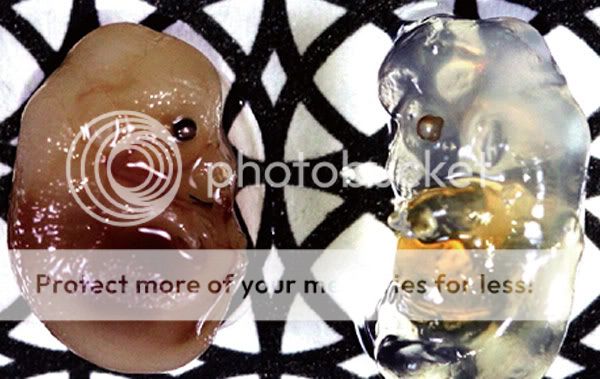
A team of Japan scientists just discovered another, madder way to study organs. They developped a chemical reagent, Scale, which turns biological tissue transparent.
Those are two mice embryo. The one on the right was treated with Scale, and now you can see everything inside.
Scale and Optical Imaging Techniques
The beauty of Scale isn't only that it can turn tissue transparent. It also does so without interfering with the fluorescent dye commonly used today in our best imagery techniques (these are very awesome, and I spoke about them in my three posts regarding the brainbow here, here and there).
This means scientists are able to colour specific tissues with a fluorescent protein and use the transparency reagent to remove all interferences. This gives them images of unprecedented clarity. The Japanese team used it to study the mouse's brain, but it is applicable to just every tissue under the sun.
What Remains to be Done
Scale currently has one big disadvantage: it's too potent to use on living organisms. Dr. Atsushi Miyawaki, the leading scientist on the japanese team, believes this could change. They're currently working on a "another, milder candidate reagent which would allow us to study live tissue in the same way, at somewhat lower levels of transparency."
If you want to know more, you can read the io9 article on the subject. I have to agree with them: the transparent embryo looks like a gummi. Yum!
We've also used specific species to study the embryo's development, such as the zebra fish, which has the awesome particularity of being transparent at that stage, and which we engineered to remain transparent all the way to adulthood.
A team of Japan scientists just discovered another, madder way to study organs. They developped a chemical reagent, Scale, which turns biological tissue transparent.
| Image courtesy of io9, very awesome science site |
Those are two mice embryo. The one on the right was treated with Scale, and now you can see everything inside.
Scale and Optical Imaging Techniques
The beauty of Scale isn't only that it can turn tissue transparent. It also does so without interfering with the fluorescent dye commonly used today in our best imagery techniques (these are very awesome, and I spoke about them in my three posts regarding the brainbow here, here and there).
This means scientists are able to colour specific tissues with a fluorescent protein and use the transparency reagent to remove all interferences. This gives them images of unprecedented clarity. The Japanese team used it to study the mouse's brain, but it is applicable to just every tissue under the sun.
What Remains to be Done
Scale currently has one big disadvantage: it's too potent to use on living organisms. Dr. Atsushi Miyawaki, the leading scientist on the japanese team, believes this could change. They're currently working on a "another, milder candidate reagent which would allow us to study live tissue in the same way, at somewhat lower levels of transparency."
If you want to know more, you can read the io9 article on the subject. I have to agree with them: the transparent embryo looks like a gummi. Yum!
Monday, August 29, 2011
Göbekli Tepe Or The Ruins That Predate Civilization
Most of the science on this blog is linked to biology or chemistry in one way or another, in large part because it's what I study in.
Today we take a look at something a little different. And by "a little", I mean a lot. I have the awesome Steph Sinkhorn to thank for one of the most major mindblowing discovery I've made in the last month: Göbekli Tepe.
What is Göbekli Tepe?
Göbekli Tepe is a set of ruins discovered on a hilltop in southeast Turkey. The complex appears to be a sanctuary of sorts. It contains multiple round subterrean structures, each of which has a series of massive limestone pillars (we're talking 8 feet tall and seven tons here). The pillars themselves are decorated with complex carvings of animals, plants and other enigmatic pictograms.
The construction of Göbekli Tepe, which involved the carving and carrying of the pillars uphill, would take a staggering amount of manpower - estimations speak of 500 men.
Okay. But the Egyptians built the pyramids, so what's the big deal?
A Little Historical Context
The big deal came with the carbon-dating. At the moment, the oldest dating on Göbekli Tepe places it at 9000 BC. They are not done digging the site, however, and most archeologist estimate the ruins' beginning to be in 11,000 BC.
Mesopotamian writing systems are estimated to the end of the 4th millenium BC.
Animal husbandry is estimated to 9000 BC.
What this means, in short, is that Göbekli Tepe was built before the Neolithic Revolution, when humans were still hunters-gatherers. Before agriculture and animal husbandry.
The hilltop sanctuary speaks of a level of organization that was never associated with the time period. Archeologists now believe a priestly caste supervised the work (good job on gathering those 500 men, there) and, afterwards, the religious ceremony that took place there.
Kind of awesome, how wrong we were about the small packs of hunter-gatherers, eh?
And Now the Actual Crazy Inspiration Part
There is something else unique with Göbekli Tepe, and I'll admit that's the part I found the most interesting. It spoke to the writer in me, because it implies a story.
Göbekli Tepe was deliberately buried under 300 to 500 cubic meters of sand. They took the sand from elsewhere and filled their sanctuary with it, and no one knows why. Protection from invaders? Preservation for future generations? Respect for a religious site no longer in usage?
We don't know. Chances are, we never will.
If you're like me, though, you are weaving an epic tale that would lead hundreds of hunter-gatherers to work together and fill their holy sites with sand, in the desperate hope that when danger passes, they can return to it and honour their gods.
Images are from Ancient Wisdom, where there's a lot more to see.
Today we take a look at something a little different. And by "a little", I mean a lot. I have the awesome Steph Sinkhorn to thank for one of the most major mindblowing discovery I've made in the last month: Göbekli Tepe.
What is Göbekli Tepe?
Göbekli Tepe is a set of ruins discovered on a hilltop in southeast Turkey. The complex appears to be a sanctuary of sorts. It contains multiple round subterrean structures, each of which has a series of massive limestone pillars (we're talking 8 feet tall and seven tons here). The pillars themselves are decorated with complex carvings of animals, plants and other enigmatic pictograms.
The construction of Göbekli Tepe, which involved the carving and carrying of the pillars uphill, would take a staggering amount of manpower - estimations speak of 500 men.
Okay. But the Egyptians built the pyramids, so what's the big deal?
A Little Historical Context
The big deal came with the carbon-dating. At the moment, the oldest dating on Göbekli Tepe places it at 9000 BC. They are not done digging the site, however, and most archeologist estimate the ruins' beginning to be in 11,000 BC.
Mesopotamian writing systems are estimated to the end of the 4th millenium BC.
Animal husbandry is estimated to 9000 BC.
What this means, in short, is that Göbekli Tepe was built before the Neolithic Revolution, when humans were still hunters-gatherers. Before agriculture and animal husbandry.
The hilltop sanctuary speaks of a level of organization that was never associated with the time period. Archeologists now believe a priestly caste supervised the work (good job on gathering those 500 men, there) and, afterwards, the religious ceremony that took place there.
Kind of awesome, how wrong we were about the small packs of hunter-gatherers, eh?
And Now the Actual Crazy Inspiration Part
There is something else unique with Göbekli Tepe, and I'll admit that's the part I found the most interesting. It spoke to the writer in me, because it implies a story.
Göbekli Tepe was deliberately buried under 300 to 500 cubic meters of sand. They took the sand from elsewhere and filled their sanctuary with it, and no one knows why. Protection from invaders? Preservation for future generations? Respect for a religious site no longer in usage?
We don't know. Chances are, we never will.
If you're like me, though, you are weaving an epic tale that would lead hundreds of hunter-gatherers to work together and fill their holy sites with sand, in the desperate hope that when danger passes, they can return to it and honour their gods.
Images are from Ancient Wisdom, where there's a lot more to see.
Monday, August 22, 2011
The Immortal Jellyfish
Nature is full of surprises and crazy exploits. Some are pretty and fascinating. Others are mindblowing.
Turritopsis nutricula is one of them.
This medusa is smaller than your fingertip, but you can bet it'll live on longer than you. In fact, barring environmental predators, it'll never die. That's right. Our friend T. nutricula is an immortal jellyfish.
Turritopsis nutricula uses a nice and simple (in appearance, anyway) trick to achieve this: it inverses its life cycle as it gets old. This jellyfish developped a special process that allows it, through the use of unique cell tissues, to reverse its aging and return to polyp form.
If you've watched The Curious Case of Benjamin Button, you know what I'm talking about. Imagine if we could from baby to old, then back to baby, forever and ever.
Crazy. Also, great fodder for far-off science-fiction or a magical race. But that's my writer brain talking.
It's a good thing T. nutricula isn't a four-feet large jellyfish, otherwise we'd have a Worldwide Giant Medusa Invasion on our hands. Meep!
Turritopsis nutricula is one of them.
This medusa is smaller than your fingertip, but you can bet it'll live on longer than you. In fact, barring environmental predators, it'll never die. That's right. Our friend T. nutricula is an immortal jellyfish.
Turritopsis nutricula uses a nice and simple (in appearance, anyway) trick to achieve this: it inverses its life cycle as it gets old. This jellyfish developped a special process that allows it, through the use of unique cell tissues, to reverse its aging and return to polyp form.
If you've watched The Curious Case of Benjamin Button, you know what I'm talking about. Imagine if we could from baby to old, then back to baby, forever and ever.
Crazy. Also, great fodder for far-off science-fiction or a magical race. But that's my writer brain talking.
It's a good thing T. nutricula isn't a four-feet large jellyfish, otherwise we'd have a Worldwide Giant Medusa Invasion on our hands. Meep!
Friday, August 12, 2011
The Penicillin of Viruses
You know what can turn an oh-my-god-can't-write-to-save-my-life day into a fairly nice one? Good Science News. Promising discoveries! Hope for our Cure-The-Sickness related future!
That's what happened when I found this article on MIT news. A team of researcher from the MIT Lincoln's laboratory developped a new drug that can identify cells infected by virus and terminate them. And that, my friend, is full of awesome.
Viruses have this badass and terrifying strategy in which they infect the host's cells, hijack their resources and begin to multiply. The cell does have a few defenses to prevent this, but most viruses have found ways to bypass and counter these. Otherwise they wouldn't, you know, still exist.
The point is that once the virus is inside the host cell, it becomes difficult to distinguish from the non-infected cells. We manage to develop specific drugs for specific viruses by hindering their unique ways to act, but viruses have such a vast array of techniques and molecules that it is almost impossible to produce one drug that affects them all.
That is what the MIT's lab achieved. One drug for most viruses.
How the hell?
OK. This is the science part. Let's try and keep it simple. Every cell has DNA, on which we have carry genetic information. In order to access that information, we create an RNA molecule (think of it as a close-cousin of DNA) from the DNA, which is then read and transformed into a protein.
DNA is double-stranded in humans -- you've all seen the double helix image. RNA, however, is single stranded. Just one long string that twists.
Basic human scheme: Double stranded DNA --> Single stranded RNA --> Protein
Here are the key points.
1. There is never any double stranded RNA in the human process.
2. There is almost always double stranded RNA in the viral duplication.
Todd Rider's drug identifies cells with double-stranded RNA inside them and hits their self-destruct button.*
Magic!
And you know the best thing about this drug? It's called DRACO. Not just for fun. The acronym means something. It is also badass.
They tested the drug against influenza (your day-to-day cold) and dengue fever (a cousin of Ebola), and it worked. These are two very very very different viruses. At the moment they're trying DRACO on other viruses in mice before moving to bigger animals, and eventually humans. So it's not ready or finished yet, but one can hope.
And for those of you who want to see more of the science, the drug's action mecanism is explained in more details in the article. Plus pictures of their tests. It's neat!
*Yes, there is such a thing in cells. It's one of the most broken mecanism of cancer cells. Self-destruct buttons: not as useless as in sci-fi movies.
That's what happened when I found this article on MIT news. A team of researcher from the MIT Lincoln's laboratory developped a new drug that can identify cells infected by virus and terminate them. And that, my friend, is full of awesome.
The Problem with Treating Viruses
Viruses have this badass and terrifying strategy in which they infect the host's cells, hijack their resources and begin to multiply. The cell does have a few defenses to prevent this, but most viruses have found ways to bypass and counter these. Otherwise they wouldn't, you know, still exist.
The point is that once the virus is inside the host cell, it becomes difficult to distinguish from the non-infected cells. We manage to develop specific drugs for specific viruses by hindering their unique ways to act, but viruses have such a vast array of techniques and molecules that it is almost impossible to produce one drug that affects them all.
That is what the MIT's lab achieved. One drug for most viruses.
How the hell?
OK. This is the science part. Let's try and keep it simple. Every cell has DNA, on which we have carry genetic information. In order to access that information, we create an RNA molecule (think of it as a close-cousin of DNA) from the DNA, which is then read and transformed into a protein.
DNA is double-stranded in humans -- you've all seen the double helix image. RNA, however, is single stranded. Just one long string that twists.
Basic human scheme: Double stranded DNA --> Single stranded RNA --> Protein
Here are the key points.
1. There is never any double stranded RNA in the human process.
2. There is almost always double stranded RNA in the viral duplication.
Todd Rider's drug identifies cells with double-stranded RNA inside them and hits their self-destruct button.*
Magic!
And you know the best thing about this drug? It's called DRACO. Not just for fun. The acronym means something. It is also badass.
They tested the drug against influenza (your day-to-day cold) and dengue fever (a cousin of Ebola), and it worked. These are two very very very different viruses. At the moment they're trying DRACO on other viruses in mice before moving to bigger animals, and eventually humans. So it's not ready or finished yet, but one can hope.
And for those of you who want to see more of the science, the drug's action mecanism is explained in more details in the article. Plus pictures of their tests. It's neat!
*Yes, there is such a thing in cells. It's one of the most broken mecanism of cancer cells. Self-destruct buttons: not as useless as in sci-fi movies.
Wednesday, July 20, 2011
Six Thousand Feet in the Air
Chose promise, chose due.
I promised to tell you all about my hot air balloon trip, and this is where it happens. This post is going to be long and full of pictures. You have been warned!
My first flight plan was cancelled due to bad weather. You don't fly if it's raining, or if the ground is wet. It'd be possible, but it takes more heat to rise, since water makes the balloon heavier. Plus, the view from the sky isn't as clear, and it's nowhere near as cool. So, we waited for the sun and a call from our trusted pilot.
The sun, it seems, decided to come one Saturday morning... at 5:30 am. Which means I was up at 4 am, a feat in and of itself! Honestly, though, I'd been semi-awake since 2 am, alternating between proper sleep and eyes-wide-open-with-excitement. Balloon Ride, my kid mind said. Proper research! my writer mind added. Happy times were to be had today.
So we got up, went there, and then moved with the four other passengers, the pilot and the rest of the crew to our take-off site. They took out the basket there, tied the enveloppe to it and only then did they begin to remove the enveloppe from its bag.
There it was. My first writerly heart attack.
When you read that something is X feet tall and X feet wide, you think "Wow, that's big." But "big" isn't a concrete measure, and in my mind at least, it doesn't really click until I've seen it. Just like it's one thing to know the Eiffel Tower is tall, another to stand underneath it and look up. Or one thing to be told that northern lights are pretty, and another to see them. Some concepts are too abstracts to grasp with a solid exemple. Hot air balloon bigginess is one.
So we weren't in the sky yet and I already had one small plot problem to solve. But I took heart: that's why I'd come (in addition to the 'having fun' part).
Besides, I wasn't going to dwell on it. Not when they asked for volunteers to hold the enveloppe's mouth open!
So now I know how it strains the arms to hold it, how freaking complicated it'd be to take off alone, how hot the air gets once they use the burners to warm it (that's why the gloves) and about how long it takes. And yep, that's another balloon preparing for take-off behind us. We were three that morning.
Unlike the enveloppe, the basket was a bit smaller than expected. We weren't squeezed inside, but any tighter and it would no longer have been comfortable. But it was comfy. Also, you don't feel a thing when you take off. You're talking and enjoying yourself, and suddenly the world lowers and you wonder why. Then you look down and see this:
Once you're in the air, the entire world shushes down. Well, okay, not for the first half hour of the flight, because I kept asking questions to the pilot. "What's that rope?" "And that big red one?" "How does it feel when you go higher? In winter? In bad weather?" "How much propane do you need?"*
Once I shut up, though... complete quiet. Nothing but the soft whistling of gas heading to the burner, and the occasional WHOOOSH when he pushed the buttons. No cars, no birds, no people. Only you, the sky and the world, 6000 feet below.
Now, enough talking and more showing. This is what it looked like from above:
Despite the fact that my mind kept wondering how I was going to fix my newly found plot problems, this hot air balloon trip is one of the most relaxing experiences I've ever had. It's an instant slow down. More than anything I've done in vacation, it took me out of my speedy-speed life and allowed me to take a breather.
The landing was super smooth too, and we shared champagne with the crew and the farmer whose field we'd used as a landing ground.
My plot problems are now fixed, thanks to the boyfriend's many thoughtful suggestions and all I've learned on the trip. It's turned a cool scene into an absolutely epic one, and added a new storyline branch to the novel. The balloon trip was a great experience, both for the novel and for the pure awesomeness of it.
Oh, and just in case you'd consider flying around Quebec City or Montreal, my pilot is Jacques Brouard. He has his own little enterprise called Québec Montgolfière and has been flying for more than 20 years now. I recommend him. Seriously.
That's the little story of my brief time in a balloon. You can ask all the questions you want in the comments if there's something you wanted to know, and that I forgot to say. :)
*The last one is super important, considering propane is a rarity in my world.
I promised to tell you all about my hot air balloon trip, and this is where it happens. This post is going to be long and full of pictures. You have been warned!
My first flight plan was cancelled due to bad weather. You don't fly if it's raining, or if the ground is wet. It'd be possible, but it takes more heat to rise, since water makes the balloon heavier. Plus, the view from the sky isn't as clear, and it's nowhere near as cool. So, we waited for the sun and a call from our trusted pilot.
The sun, it seems, decided to come one Saturday morning... at 5:30 am. Which means I was up at 4 am, a feat in and of itself! Honestly, though, I'd been semi-awake since 2 am, alternating between proper sleep and eyes-wide-open-with-excitement. Balloon Ride, my kid mind said. Proper research! my writer mind added. Happy times were to be had today.
So we got up, went there, and then moved with the four other passengers, the pilot and the rest of the crew to our take-off site. They took out the basket there, tied the enveloppe to it and only then did they begin to remove the enveloppe from its bag.
| IT IS FREAKIN' HUGE!! |
When you read that something is X feet tall and X feet wide, you think "Wow, that's big." But "big" isn't a concrete measure, and in my mind at least, it doesn't really click until I've seen it. Just like it's one thing to know the Eiffel Tower is tall, another to stand underneath it and look up. Or one thing to be told that northern lights are pretty, and another to see them. Some concepts are too abstracts to grasp with a solid exemple. Hot air balloon bigginess is one.
So we weren't in the sky yet and I already had one small plot problem to solve. But I took heart: that's why I'd come (in addition to the 'having fun' part).
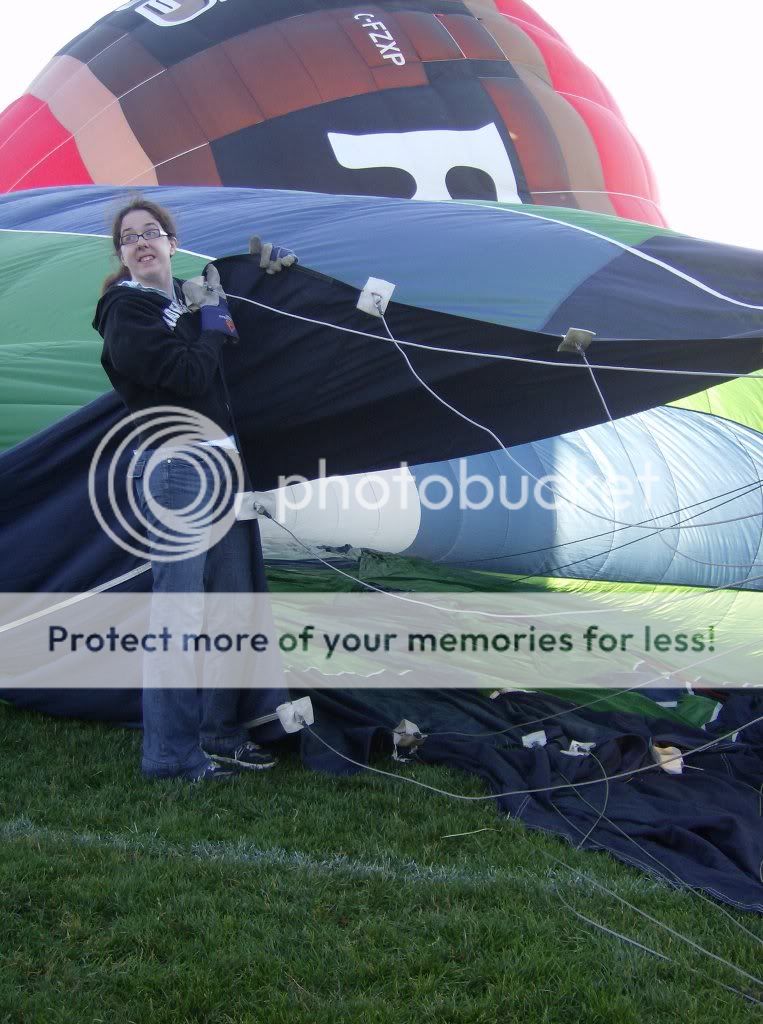
Besides, I wasn't going to dwell on it. Not when they asked for volunteers to hold the enveloppe's mouth open!
| Me with a crazy face, holding the enveloppe |
Unlike the enveloppe, the basket was a bit smaller than expected. We weren't squeezed inside, but any tighter and it would no longer have been comfortable. But it was comfy. Also, you don't feel a thing when you take off. You're talking and enjoying yourself, and suddenly the world lowers and you wonder why. Then you look down and see this:
| That's the third balloon. It was quite smaller |
Once I shut up, though... complete quiet. Nothing but the soft whistling of gas heading to the burner, and the occasional WHOOOSH when he pushed the buttons. No cars, no birds, no people. Only you, the sky and the world, 6000 feet below.
Now, enough talking and more showing. This is what it looked like from above:
| That's Quebec City on the other side of the St-Lawrence River |
| FWOOOOSH! |
| I call it the Brocoli Forest |
| We're at 3000 ft now. Nope, they did not crash in the river |
The landing was super smooth too, and we shared champagne with the crew and the farmer whose field we'd used as a landing ground.
| That's my pilot, in his super cool hat. He's awesome, funny and talkative. |
Oh, and just in case you'd consider flying around Quebec City or Montreal, my pilot is Jacques Brouard. He has his own little enterprise called Québec Montgolfière and has been flying for more than 20 years now. I recommend him. Seriously.
That's the little story of my brief time in a balloon. You can ask all the questions you want in the comments if there's something you wanted to know, and that I forgot to say. :)
*The last one is super important, considering propane is a rarity in my world.
Friday, June 10, 2011
The Science that Creeps ME Out
Yesterday I asked you what aspect of science you found the most terrifying. Creepy. Shiver-inducing. I love the answers I got. It's fascinating how some of your fears are another person's great love, and how many are directly related to my field.
Not that I spend my time modifying the genetic bagagge of plants or animals. I spend my time trying to determine what makes leukemic cells grow faster and how -- which does mean, yes, that I am researching on ways to stave off cancer. And when I put it that way, I feel like a superhero!
Back on topic. It wouldn't be fair if I didn't share my own sciency fear.
It's not a particular virus that scares me. It's the way viruses are built. It's both fascinating and utterly terrifying.
Viruses are death machines on a microscopical level. The basic structure is a DNA or RNA strand, with the virus' information on it, protected by a capside (proteins). The virus, through many different ways, will try to force its DNA (or RNA, but I'll stop repeating RNA now) into a cell and hijack all its resources.
Okay, a parasite like any other, no?
The scary thing comes in the virus' simple structure. I just explained it to you with a single sentence! One DNA strand and proteins. Yes, there are variations, but the simplest virus won't need anything else to invade and duplicate.
There isn't a single DNA base wasted on a virus. Everything it needs to take over your cell is comprised in its strand, and the strand itself is super short. The smallest has 3,569 bases and needs only 20 minutes to kill a cell (it's a bacteria cell, we're safe!). The biggest has 1,181,404 bases.
To compare, an E. coli (one of the simplest and most studied bacteria) has 4,600,000 and the human genome is 3,200,000,000. If you do the math, that means that even the biggest virus has a genome that is 2709 times smaller than ours.
When a virus invades a cell, it forces it to create a hundred copies (on average) of itself. That means there are suddenly 100 more viruses in the environment that can invade other cells. And on it goes.
Think about how efficient this is. If I had to find a way to wipe out any living organism, I'd tamper with a virus until it could infect and kill said organism.
Yes, we have defences. So does bacterias, and yet in 48 hours, phages (virus that solely infect bacterias) wipe out half the bacteria population.
Killing machines.
And that, my friends, is why my villain is a genetic engineer*. Because I'm terrified of what a genius could do if he managed to bypass ethic commitees and surveillance to develop his own super-viruses.
There you go! Nice fodder for the weekend, eh?
*If you're going to use viruses or other such things in your novel, I invite you to do the research for specific effects/modes of infection. OR, if you know what you want but aren't sure what viruses would do that, you can send yours truly an e-mail. I did have a whole class on the subject, and I'm aware how confusing it can get even when it's your domain.
Not that I spend my time modifying the genetic bagagge of plants or animals. I spend my time trying to determine what makes leukemic cells grow faster and how -- which does mean, yes, that I am researching on ways to stave off cancer. And when I put it that way, I feel like a superhero!
Back on topic. It wouldn't be fair if I didn't share my own sciency fear.
| Photo by Sebastian Kaulitzki |
Viruses
It's not a particular virus that scares me. It's the way viruses are built. It's both fascinating and utterly terrifying.
Viruses are death machines on a microscopical level. The basic structure is a DNA or RNA strand, with the virus' information on it, protected by a capside (proteins). The virus, through many different ways, will try to force its DNA (or RNA, but I'll stop repeating RNA now) into a cell and hijack all its resources.
Okay, a parasite like any other, no?
The scary thing comes in the virus' simple structure. I just explained it to you with a single sentence! One DNA strand and proteins. Yes, there are variations, but the simplest virus won't need anything else to invade and duplicate.
There isn't a single DNA base wasted on a virus. Everything it needs to take over your cell is comprised in its strand, and the strand itself is super short. The smallest has 3,569 bases and needs only 20 minutes to kill a cell (it's a bacteria cell, we're safe!). The biggest has 1,181,404 bases.
To compare, an E. coli (one of the simplest and most studied bacteria) has 4,600,000 and the human genome is 3,200,000,000. If you do the math, that means that even the biggest virus has a genome that is 2709 times smaller than ours.
When a virus invades a cell, it forces it to create a hundred copies (on average) of itself. That means there are suddenly 100 more viruses in the environment that can invade other cells. And on it goes.
Think about how efficient this is. If I had to find a way to wipe out any living organism, I'd tamper with a virus until it could infect and kill said organism.
Yes, we have defences. So does bacterias, and yet in 48 hours, phages (virus that solely infect bacterias) wipe out half the bacteria population.
Killing machines.
And that, my friends, is why my villain is a genetic engineer*. Because I'm terrified of what a genius could do if he managed to bypass ethic commitees and surveillance to develop his own super-viruses.
There you go! Nice fodder for the weekend, eh?
*If you're going to use viruses or other such things in your novel, I invite you to do the research for specific effects/modes of infection. OR, if you know what you want but aren't sure what viruses would do that, you can send yours truly an e-mail. I did have a whole class on the subject, and I'm aware how confusing it can get even when it's your domain.
Friday, June 3, 2011
My Microscopic Soulmate
I always thought I was a big coffee drinker. I've drank so much of it in the last five years that I can now spend a whole evening drinking it non-stop and still fall asleep at regular hours (regular for me, mind you). At times, like many friends in a similar position, I have joked that I could live on caffeine.
Little did I know, my caffeine consumption is a real joke compared to Pseudomonas Putida CBB5.
Pseudomonas putida is a soil bacteria strain that was recently discovered on an University Campus. It has the epic capability of breaking down the caffeine molecule - which is made of carbon, nitrogen, oxygene and hydrogen, the four fundamental organic elements - into dioxide carbon and ammonia. And when it does that? It creates energy.
As humans, when we process caffeine, we break it down into useless part and excrete it through urine. We don't create energy from caffeine (the boost your getting is the molecule's influence on other parts of your system, not actual energy).
This little bugger can live on a caffeine-only diet. It doesn't need anything else to survive, and will thrive in a highly-caffeinated petri dish. We had the dowright scary flesh-eating bacteria. Now we also have the epic caffeine-eating bacteria.
So to Ryan Summers and his team, thank you for discovering my microscopic soulmate.* Now when I drink over 30 oz of coffee over the span of a few hours, I know that on university campuses all over the world, thousands of billions of Pseudomonas putida** CBB5 are doing the same.
*For the record this research has an actual point. The enzyme could be used in treating heart arrhythmias or asthma, or to boost blood flow. They could also help clear out excess caffeine from the process creating decaf coffee.
**I have no actual idea of how common this strain is.
***I like asterixes. I'm also unsure that's their English name (educate me, dear readers!)
Little did I know, my caffeine consumption is a real joke compared to Pseudomonas Putida CBB5.
Pseudomonas putida is a soil bacteria strain that was recently discovered on an University Campus. It has the epic capability of breaking down the caffeine molecule - which is made of carbon, nitrogen, oxygene and hydrogen, the four fundamental organic elements - into dioxide carbon and ammonia. And when it does that? It creates energy.
As humans, when we process caffeine, we break it down into useless part and excrete it through urine. We don't create energy from caffeine (the boost your getting is the molecule's influence on other parts of your system, not actual energy).
This little bugger can live on a caffeine-only diet. It doesn't need anything else to survive, and will thrive in a highly-caffeinated petri dish. We had the dowright scary flesh-eating bacteria. Now we also have the epic caffeine-eating bacteria.
So to Ryan Summers and his team, thank you for discovering my microscopic soulmate.* Now when I drink over 30 oz of coffee over the span of a few hours, I know that on university campuses all over the world, thousands of billions of Pseudomonas putida** CBB5 are doing the same.
*For the record this research has an actual point. The enzyme could be used in treating heart arrhythmias or asthma, or to boost blood flow. They could also help clear out excess caffeine from the process creating decaf coffee.
**I have no actual idea of how common this strain is.
***I like asterixes. I'm also unsure that's their English name (educate me, dear readers!)
Friday, May 27, 2011
Rosalind Franklin and the DNA discovery
Ladies and gents, I present to you, Rosalind Franklin:
This lady here is a british biophysicist, most known for her work in x-ray crystallography. She was a specialist in the field, and had successfully obtained what was qualified by another scientist, J. D. Bernal, as "amongst the most beautiful x-ray photographs of any substance ever taken".
I'm not discussing Franklin only because she was a good at x-rays, though in itself it's quite an achievement. Franklin had a great deal to do with the discovery of DNA structure, because she managed to take this picture:
This, to a crystallograph, reads as "double helix". Apparently it's super obvious. I don't know. I'm no crystallograph.
What I do know was that this picture, one of the key elements leading to the discovery of DNA structure by Crick and Watson, was taken by Franklin's colleague and showed it, without her permission, to Crick and Watson.
They built their model based on this x-ray photograph, in addition to everything else they knew. Most think they couldn't have done it without Franklin's photo -- at least not so fast, which means they might not have been the first.
Now, not to remove the credit from Watson and Crick. They put together many pieces of a complex puzzle and came out with the right answer. That's an incredible achievement.
When they published their structure in 1953, however, the only mention of Franklin's work was as a footnote. Ten years later, Watson published a memoir recounting his discovery of DNA structure, The Double Helix. He discredited Rosalind Franklin on every occasion, calling her 'Rosy' and burying her contributions under allegations that she couldn't interpret her own data.
Crick, Watson and Wilkins received a Nobel Prize in 1962 for their work on DNA and other nucleid acids.
Franklin died in 1958, at 37, due to the consequence of x-ray exposure (turns out, x-rays are like radium in this regard).
The rules of Nobel Prizes forbid posthumous nominations. Her name isn't on it, and will never be.
Thankfully, her story is becoming more widely known, and she is increasingly frequently included in the tales behind the discovery of DNA structure, perhaps one of the biggest scientific discovery of our times.
This lady here is a british biophysicist, most known for her work in x-ray crystallography. She was a specialist in the field, and had successfully obtained what was qualified by another scientist, J. D. Bernal, as "amongst the most beautiful x-ray photographs of any substance ever taken".
I'm not discussing Franklin only because she was a good at x-rays, though in itself it's quite an achievement. Franklin had a great deal to do with the discovery of DNA structure, because she managed to take this picture:
| Photograph 51 |
What I do know was that this picture, one of the key elements leading to the discovery of DNA structure by Crick and Watson, was taken by Franklin's colleague and showed it, without her permission, to Crick and Watson.
They built their model based on this x-ray photograph, in addition to everything else they knew. Most think they couldn't have done it without Franklin's photo -- at least not so fast, which means they might not have been the first.
Now, not to remove the credit from Watson and Crick. They put together many pieces of a complex puzzle and came out with the right answer. That's an incredible achievement.
When they published their structure in 1953, however, the only mention of Franklin's work was as a footnote. Ten years later, Watson published a memoir recounting his discovery of DNA structure, The Double Helix. He discredited Rosalind Franklin on every occasion, calling her 'Rosy' and burying her contributions under allegations that she couldn't interpret her own data.
Crick, Watson and Wilkins received a Nobel Prize in 1962 for their work on DNA and other nucleid acids.
Franklin died in 1958, at 37, due to the consequence of x-ray exposure (turns out, x-rays are like radium in this regard).
The rules of Nobel Prizes forbid posthumous nominations. Her name isn't on it, and will never be.
Thankfully, her story is becoming more widely known, and she is increasingly frequently included in the tales behind the discovery of DNA structure, perhaps one of the biggest scientific discovery of our times.
Tuesday, May 24, 2011
Coming Soon: The History Behind the Science
There are a great deal of women who were important to the history of science, and who were either purposefully erased from the records, simply forgotten, or had to go under a man's name for publication.
The truth is, when it comes to science, there's one thing I like more than the science itself... and that's the history behind it. Most important discoveries have a cool story behind them, and some are even a case of intense backstabbing -- as good as any political intrigue, if you ask me!
As inspired by this recent xkcd comic (the same Sommer posted at Tell Great Stories, for those who hang out at both blogs), I'll try to dig out some cool science discoveries for you. It might look something like the post on Osamu Shimomura, and the bit on how close he was to Nagasaki.
If you have any suggestions for these, especially if they are oft-forgotten women, please e-mail them to me at claudiea.writer AT gmail.com I have a few topics lined up, but I want this to run as long as I can make it.
Starting Friday, with Rosalind Franklin and the discovery of DNA.
The truth is, when it comes to science, there's one thing I like more than the science itself... and that's the history behind it. Most important discoveries have a cool story behind them, and some are even a case of intense backstabbing -- as good as any political intrigue, if you ask me!
As inspired by this recent xkcd comic (the same Sommer posted at Tell Great Stories, for those who hang out at both blogs), I'll try to dig out some cool science discoveries for you. It might look something like the post on Osamu Shimomura, and the bit on how close he was to Nagasaki.
If you have any suggestions for these, especially if they are oft-forgotten women, please e-mail them to me at claudiea.writer AT gmail.com I have a few topics lined up, but I want this to run as long as I can make it.
Starting Friday, with Rosalind Franklin and the discovery of DNA.
Friday, May 20, 2011
Racking Tips
It's been two weeks now since I started my internship, and the experiments I'm running allows for a lot of downtime.
If any of you have watched TV shows with *real* (hahahaha) science such as, let's say, CSI*, you've probably seen scientists put pipettes in the plastic little buggers in that picture (or any bigger, more colourful variant of these).
These are plastic tips. To the great dismay of scientists worldwide, they don't come with the box. You have to put all 96 plastic tips in the rack and then sterilise them before you can use them.
The kind of mindless, menial task nobody wants to do.
What does this have to do with writing? Well, your mind might have lit up at the word menial or mindless. Not that writing is either. It's been said before, however, that such tasks are great for writing.
I'm not sure what about the small, repetitive physical tasks frees the mind to go elsewhere, but it works wonders. Your imagination shifts into high gears and speeds away, running down new paths.
The folks at my lab don't understand why I love racking tips so much. If they saw how much I've managed to unravel and decide about one of my writing project, though, they would.
Try it next time you're stuck! Find some dishes to wash, a room to clean or clothes to fold, and you might find your writer's block isn't as big as you thought!
*It should be said that I watch and like CSI. It's okay if they take a hour to do something that might require 3-4 days. I don't mind. It's fun nonetheless.
Sunday, May 15, 2011
A Giant KAPOW!
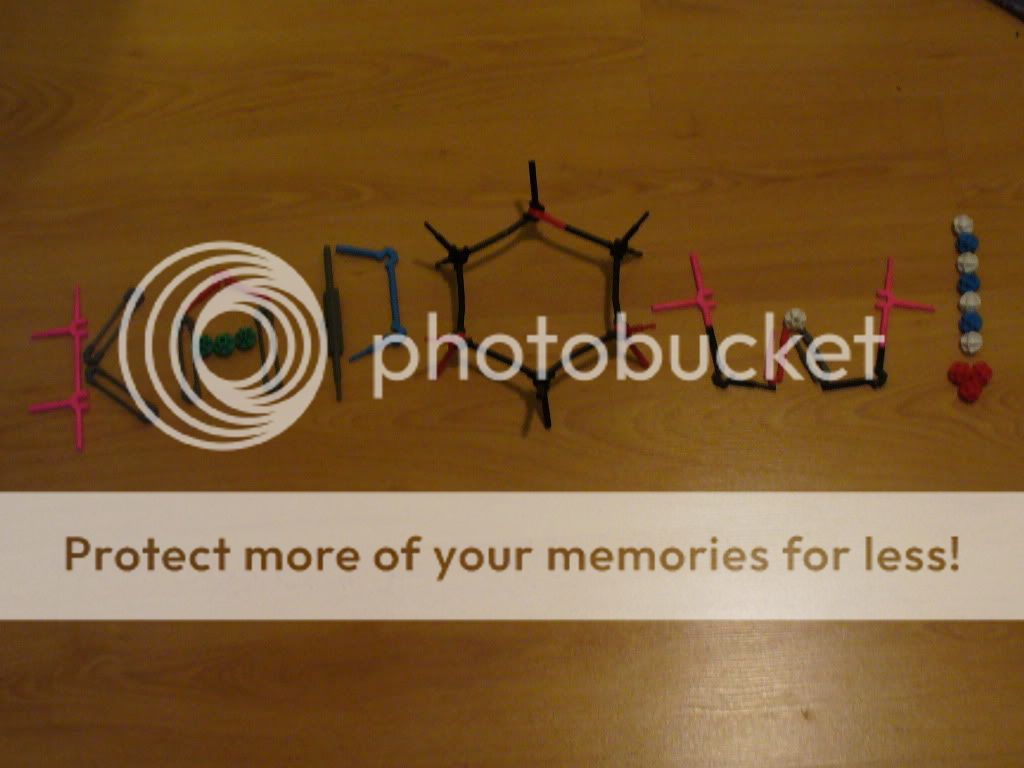
| Molecular models for the win! |
I hope you backed up your lives, ladies and gentleman, as today might be the end of us all.
May 12th. A plague unleashed upon us all. A young boy, trading a corndog for a spaceship, shooting into space and blowing up the universe. Be ready for it!
It's time to party!
May 12th is the release date of Jacob Wonderbar and the Giant Space Kapow, by the most awesome Nathan Bransford, whose blog and forums I've squatted for months now. Did I say he is awesome? Oh yes, I said he was awesome.
In honour of this launch, here is one explosive mix: Alkali Metals and Water!
P.S: Thursday is my post day at Wicked & Tricksy! Come check it out, if you dare.
Friday, May 13, 2011
The Brainbow!
This is the third post of a three-part series on fluorescent proteins and neurobiology. The first part is on Osamu Shimomura and the second on the mutations made in the proteins (shiny pictures included).
This, my friend, is what your brain looks like. Or, well, what it would look like if we used the fluorescent proteins in it.
You remember how last Tuesday I explained they could add a fluorescent protein to any other, making it easy to detect? And you remember the various colours created through genetic mutations? (If you don't, link at the top.)
Well, the Brainbow is perhaps the most spectacular use of this technique. Each individual neuron expresses a different amount of the red, blue and green mutants of the original GFP. Because the mix is not the same in each neuron, the resulting colour varies with every single neuron.
You can see, the result is striking. Since the technique was developped in 2007, multiple pictures were taken, some winning scientific images awards.
So here are some others, for your enjoyment!
Today? Today is... the BRAINBOW!
| Brainbow image of hippocampal neurons. Courtesy of Jeff Lichtman/Harvard University |
This, my friend, is what your brain looks like. Or, well, what it would look like if we used the fluorescent proteins in it.
You remember how last Tuesday I explained they could add a fluorescent protein to any other, making it easy to detect? And you remember the various colours created through genetic mutations? (If you don't, link at the top.)
Well, the Brainbow is perhaps the most spectacular use of this technique. Each individual neuron expresses a different amount of the red, blue and green mutants of the original GFP. Because the mix is not the same in each neuron, the resulting colour varies with every single neuron.
You can see, the result is striking. Since the technique was developped in 2007, multiple pictures were taken, some winning scientific images awards.
So here are some others, for your enjoyment!
| Brainbow image of the dentate gyrus. Courtesy of Jeff Lichtman/Harvard University |
| Confocal microscopy by Tamily A. Weissman |
I don't know for you, guys, but at this point I just call this art. Brainbow pictures give me an instant geekgasm. Neurons! With colours! Not to mention, this highlights the amazing complexity of our brains, and how much we've yet to learn about ourselves.
Kudos to the scientists working tirelessly on it. I'm too busy staring at the pretty picture!
Tuesday, May 10, 2011
Fluorescent Proteins Part 2: Genetic Manipulations
This is the second post of a three-part series on fluorescent proteins and neurobiology. The first part is on Osamu Shimomura and the third will be on... the Brainbow! I really can't wait to get to the brainbow.
So, our good friend Osamu Shimomura discovered green fluorescent protein in a tiny jellyfish. Cool, right? But what the hell can they do with this?
In 1962, not much. When genetic engineer techniques evolved and became viable researched tools in the 1980s, the possibilities becameendless many.
The awesome thing with GFP is that you can attach it to other proteins. You just put the gene for it next to the other protein's gene, and when the cell produces the protein, it has a GFP attached to it. It's like magic, only it's real!
Proving the GFP could be attached and expressed by cells was made at Martin Chalfie's lab, the second recipient of the 2008 Nobel prize.
What they do with these proteins is that they attach it to another, then they send light of a particular wavelength on it. It absorbs, and gives back light at a different wavelength. It's not hard to detect that light, and the images we get are better with every passing year.
They modified the GFP to give it a wide range of colours and make it easier to insert. This work was made at Roger Tsien's laboratory. Tsien is the third recipient of the 2008 Nobel prize. He created mutants that were stable and produced a lot of fluorescence.
Then he and his lab had fun, put the proteins in bacteria and... created a beach!
That, my friends, is science at its best. Crazy and pretty!
So, our good friend Osamu Shimomura discovered green fluorescent protein in a tiny jellyfish. Cool, right? But what the hell can they do with this?
In 1962, not much. When genetic engineer techniques evolved and became viable researched tools in the 1980s, the possibilities became
The awesome thing with GFP is that you can attach it to other proteins. You just put the gene for it next to the other protein's gene, and when the cell produces the protein, it has a GFP attached to it. It's like magic, only it's real!
Proving the GFP could be attached and expressed by cells was made at Martin Chalfie's lab, the second recipient of the 2008 Nobel prize.
What they do with these proteins is that they attach it to another, then they send light of a particular wavelength on it. It absorbs, and gives back light at a different wavelength. It's not hard to detect that light, and the images we get are better with every passing year.
They modified the GFP to give it a wide range of colours and make it easier to insert. This work was made at Roger Tsien's laboratory. Tsien is the third recipient of the 2008 Nobel prize. He created mutants that were stable and produced a lot of fluorescence.
| Pretty colours! |
Then he and his lab had fun, put the proteins in bacteria and... created a beach!
That, my friends, is science at its best. Crazy and pretty!
Friday, May 6, 2011
Fluorescent Proteins Part 1: Osamu Shimomura
This is the first post of a three-part series on fluorescent proteins and neurobiology. The second part is on the genetic mutations these proteins underwent and the third is on a spectacular use of them... the Brainbow! There will be shiny pictures, I promise.
You remember when I said there'd be more science around the blog? Well, it starts today and continues next week, with a short serie on neurophotonics.
Our first topic is Osamu Shimomura, recipient of the 2008 Chemistry Nobel Prize (with two others) and finder of the first green fluorescent protein.
Let's have a little history!
Back in the 1962, a molecular and marine biologist, Osamu Shimomura, discovered and isolated a fluorescent protein from the jellyfish Aequorea victoria. He might not have realised it back then, but this discovery would one day push neurology into a new era.
Osamu Shimomura has an interesting history, which is why he gets his own post. He lived in Isahaya, Nagasaki in 1945, 15 miles from the atomic bomb's epicenter. He was 16 at the time. Apparently, the bomb's explosion blinded him for thirty seconds, and he was later drenched by the bomb's "black rain" fallout. I don't know for you, but it feels crazy to think that if he'd been, say, visiting Nagasaki that day, neurology wouldn't be half as advanced as it is today.
At the same time, if the bomb had not been dropped, Shimomura might never have gone into sciences. To this day, he recalls having no interest in the subject at the time. In post-war Japan, however, you don't have that many educational choices. The bomb had destroyed the Nagasaki Medical College, forcing the pharmacy school to move... at a campus near his home. He joined, got his degree, and from there continued to the Nagasaki University, where he met his wife.
Life, huh?
His work with fluorescent protein was noticed by an american professor, Frank Johnson, who invited to Princeton to join his team in 1960.
Despite being found in 1962, it wasn't until the early 90s that biochemists began to realise the green fluorescent proteins' potential as a research tool.
But that's for next week! You can expect many cool pictures of fluorescent madness. What they do with these proteins is outright crazy.
You remember when I said there'd be more science around the blog? Well, it starts today and continues next week, with a short serie on neurophotonics.
Our first topic is Osamu Shimomura, recipient of the 2008 Chemistry Nobel Prize (with two others) and finder of the first green fluorescent protein.
| This guy! |
Back in the 1962, a molecular and marine biologist, Osamu Shimomura, discovered and isolated a fluorescent protein from the jellyfish Aequorea victoria. He might not have realised it back then, but this discovery would one day push neurology into a new era.
Osamu Shimomura has an interesting history, which is why he gets his own post. He lived in Isahaya, Nagasaki in 1945, 15 miles from the atomic bomb's epicenter. He was 16 at the time. Apparently, the bomb's explosion blinded him for thirty seconds, and he was later drenched by the bomb's "black rain" fallout. I don't know for you, but it feels crazy to think that if he'd been, say, visiting Nagasaki that day, neurology wouldn't be half as advanced as it is today.
At the same time, if the bomb had not been dropped, Shimomura might never have gone into sciences. To this day, he recalls having no interest in the subject at the time. In post-war Japan, however, you don't have that many educational choices. The bomb had destroyed the Nagasaki Medical College, forcing the pharmacy school to move... at a campus near his home. He joined, got his degree, and from there continued to the Nagasaki University, where he met his wife.
Life, huh?
His work with fluorescent protein was noticed by an american professor, Frank Johnson, who invited to Princeton to join his team in 1960.
Despite being found in 1962, it wasn't until the early 90s that biochemists began to realise the green fluorescent proteins' potential as a research tool.
But that's for next week! You can expect many cool pictures of fluorescent madness. What they do with these proteins is outright crazy.
Tuesday, April 19, 2011
P - Project Aether
I have a thing for hot air balloons. It's not a coincidence they are a major part of my current WiP. I think balloons are awesome, cute and romantic.
So when my boyfriend linked me to Project Aether and their youtube video, I had a bit of a geekgasm.
These people basically launch a high-altitude balloon equipped with a HD camera. And by 'high altitude', I mean SPACE. The images they filmed are incredible. Beautiful. Powerful.
Yes, the video is 11 minutes. It shows the balloon flying up. Waaay up. Let it load in the background and skip parts if you must, but watch it. Oh, and use Full Screen Mode for full effect. It's worth it.
Enjoy the ride!
So when my boyfriend linked me to Project Aether and their youtube video, I had a bit of a geekgasm.
These people basically launch a high-altitude balloon equipped with a HD camera. And by 'high altitude', I mean SPACE. The images they filmed are incredible. Beautiful. Powerful.
Yes, the video is 11 minutes. It shows the balloon flying up. Waaay up. Let it load in the background and skip parts if you must, but watch it. Oh, and use Full Screen Mode for full effect. It's worth it.
Enjoy the ride!
Thursday, March 24, 2011
The True Magic is Inside Us
Have you ever stared at the starred sky and fell like a small dot in a large universe? A mere speck in the cycle of life?
EDIT: Somehow xkcd managed to post something related to this on the following day. Check it out, it's hilarious.
Most of us have, at one point, felt the strange aloofness that comes with the realisation we're just one human being in a big scheme, and that all perspective kept, we're not so important after all. There's something special to the knowledge that there are billions of other planets out there and that we'll never really know what they're made of or if there's anything living on them. The stars and the universe are, without a doubt, a source of human wonder.
To me, however, the real magic is far closer.
It's in ourselves. In every of our cells. In the million of different proteins. In the amazing diversity you can achieve with 30,000 genes.
Just as the universe's real size is beyond our comprehension, so is the human body's complexity.
Studying biochemistry has taught me that nature's ingeniosity knows no bound. Every little process is regulated with chirurgical precision. Every millisecond, hundreds of thousands of chemical chain reactions happen. And as you read this, hundreds of small electrical currents run along you neurons, at a precise voltage to keep the signal at the right level, and each of them carries information for your brain or orders for your muscles.
Human physiology is a delicate but masterful balance. Our life depends on it and yet, everything happens without us noticing.
Every time I stop to consider the hidden beauty of our body, my mind is blown. It is, to my sense, real-life magic.
For some spacy mind-blowing, you can listen to Hank Green:
EDIT: Somehow xkcd managed to post something related to this on the following day. Check it out, it's hilarious.
Subscribe to:
Posts (Atom)