Most of the science on this blog is linked to biology or chemistry in one way or another, in large part because it's what I study in.
Today we take a look at something a little different. And by "a little", I mean a lot. I have the awesome Steph Sinkhorn to thank for one of the most major mindblowing discovery I've made in the last month: Göbekli Tepe.
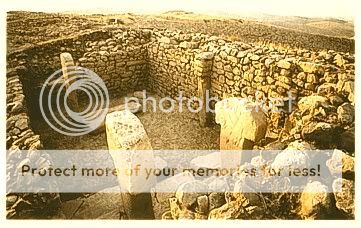
What is Göbekli Tepe?
Göbekli Tepe is a set of ruins discovered on a hilltop in southeast Turkey. The complex appears to be a sanctuary of sorts. It contains multiple round subterrean structures, each of which has a series of massive limestone pillars (we're talking 8 feet tall and seven tons here). The pillars themselves are decorated with complex carvings of animals, plants and other enigmatic pictograms.
The construction of Göbekli Tepe, which involved the carving and carrying of the pillars uphill, would take a staggering amount of manpower - estimations speak of 500 men.
Okay. But the Egyptians built the pyramids, so what's the big deal?
A Little Historical Context
The big deal came with the carbon-dating. At the moment, the oldest dating on Göbekli Tepe places it at 9000 BC. They are not done digging the site, however, and most archeologist estimate the ruins' beginning to be in 11,000 BC.
Mesopotamian writing systems are estimated to the end of the 4th millenium BC.
Animal husbandry is estimated to 9000 BC.
What this means, in short, is that Göbekli Tepe was built before the Neolithic Revolution, when humans were still hunters-gatherers. Before agriculture and animal husbandry.
The hilltop sanctuary speaks of a level of organization that was never associated with the time period. Archeologists now believe a priestly caste supervised the work (good job on gathering those 500 men, there) and, afterwards, the religious ceremony that took place there.
Kind of awesome, how wrong we were about the small packs of hunter-gatherers, eh?
And Now the Actual Crazy Inspiration Part
There is something else unique with Göbekli Tepe, and I'll admit that's the part I found the most interesting. It spoke to the writer in me, because it implies a story.
Göbekli Tepe was deliberately buried under 300 to 500 cubic meters of sand. They took the sand from elsewhere and filled their sanctuary with it, and no one knows why. Protection from invaders? Preservation for future generations? Respect for a religious site no longer in usage?
We don't know. Chances are, we never will.
If you're like me, though, you are weaving an epic tale that would lead hundreds of hunter-gatherers to work together and fill their holy sites with sand, in the desperate hope that when danger passes, they can return to it and honour their gods.
Images are from Ancient Wisdom, where there's a lot more to see.
Showing posts with label history. Show all posts
Monday, August 29, 2011
Monday, July 25, 2011
Worldbuilding with a Timeline
Of all the things very characteristic of speculative fiction, worldbuilding is probably my favourite. There is something enchanting in the act of bringing a whole different universe to life, mashing up together original concepts (if there is such a thing) with classic trends of humanity. Not to mention the effect one idea has on the rest of the setting. Connecting the dots through explanations, consequences and other Cool Ideas.
It's all fun, almost no work. To me, anyway.
There comes a point where I have all a bunch of important ideas laid out, though, and while my head has a difformed map in it, I can no longer go on without one. Geography is IMPORTANT. Yep, capital letters and all.
It is a simple truth that almost eluded me when I started worldbuilding for White Echoes. Because, well, in science fiction travel is a lot easier. Distances don't quite mean the same. Important, yes, these days when we think of going from A to B, we don't often consider the geography. A plane will take us over.
Except I have a world where there are no planes, only zeppelins, and these are restricted. Not to mention a whole bunch of factors that make travelling costly and all.
Even more importantly... this world has a past. Unless there is a good reason for which humans could always travel easy and cheap, there will have been a point in history in which things such as rivers and mountains mattered. Even today, ships are an important way to move cargo and a large port will be an important economic advantage.
All of this to say, think not only of the present, but also of the past. When you place important cities on a map, create frontiers between kingdoms or invent epic conflict between nations, never forget to consider not only what is today, but how it was in the past.
It's an obvious lesson, but one I just had to remind myself of. Thought I'd share.
(Also, there will be a mappish post in the close future. Because I happen to like maps, and I happen to like sharing things I like. Yep.)
It's all fun, almost no work. To me, anyway.
There comes a point where I have all a bunch of important ideas laid out, though, and while my head has a difformed map in it, I can no longer go on without one. Geography is IMPORTANT. Yep, capital letters and all.
It is a simple truth that almost eluded me when I started worldbuilding for White Echoes. Because, well, in science fiction travel is a lot easier. Distances don't quite mean the same. Important, yes, these days when we think of going from A to B, we don't often consider the geography. A plane will take us over.
Except I have a world where there are no planes, only zeppelins, and these are restricted. Not to mention a whole bunch of factors that make travelling costly and all.
Even more importantly... this world has a past. Unless there is a good reason for which humans could always travel easy and cheap, there will have been a point in history in which things such as rivers and mountains mattered. Even today, ships are an important way to move cargo and a large port will be an important economic advantage.
All of this to say, think not only of the present, but also of the past. When you place important cities on a map, create frontiers between kingdoms or invent epic conflict between nations, never forget to consider not only what is today, but how it was in the past.
It's an obvious lesson, but one I just had to remind myself of. Thought I'd share.
(Also, there will be a mappish post in the close future. Because I happen to like maps, and I happen to like sharing things I like. Yep.)
Tuesday, May 24, 2011
Coming Soon: The History Behind the Science
There are a great deal of women who were important to the history of science, and who were either purposefully erased from the records, simply forgotten, or had to go under a man's name for publication.
The truth is, when it comes to science, there's one thing I like more than the science itself... and that's the history behind it. Most important discoveries have a cool story behind them, and some are even a case of intense backstabbing -- as good as any political intrigue, if you ask me!
As inspired by this recent xkcd comic (the same Sommer posted at Tell Great Stories, for those who hang out at both blogs), I'll try to dig out some cool science discoveries for you. It might look something like the post on Osamu Shimomura, and the bit on how close he was to Nagasaki.
If you have any suggestions for these, especially if they are oft-forgotten women, please e-mail them to me at claudiea.writer AT gmail.com I have a few topics lined up, but I want this to run as long as I can make it.
Starting Friday, with Rosalind Franklin and the discovery of DNA.
The truth is, when it comes to science, there's one thing I like more than the science itself... and that's the history behind it. Most important discoveries have a cool story behind them, and some are even a case of intense backstabbing -- as good as any political intrigue, if you ask me!
As inspired by this recent xkcd comic (the same Sommer posted at Tell Great Stories, for those who hang out at both blogs), I'll try to dig out some cool science discoveries for you. It might look something like the post on Osamu Shimomura, and the bit on how close he was to Nagasaki.
If you have any suggestions for these, especially if they are oft-forgotten women, please e-mail them to me at claudiea.writer AT gmail.com I have a few topics lined up, but I want this to run as long as I can make it.
Starting Friday, with Rosalind Franklin and the discovery of DNA.
Subscribe to:
Posts (Atom)