Yesterday I started my third week in my Creative Writing program. If you've been around this blog for a while, you'll have noted my posting rate went down. It isn't a coincidence. There is a lot to read and a lot to write. I'm super busy.
The good part? I have never loved being buried under a pile of schoolwork this much. I'm having a blast!
I'll say this: most of the general writing advice I've received are things I've heard on the interwebs before. Watch out for the "feel", "realize" or "see" in the texts. Don't step out of the POV. Have a strong opening paragraph. Show don't tell (though this one was phrased nicely. My teacher said "Remember, you have little to say but a lot to show).
I expected this. I've been digging the internet for writing pearls for at least two years now. Not that I've heard it all, but I believe I have a fair grasp on what I should do. It's applying it that is difficult. I came to the program to write texts and be critiqued, to receive personalised advice.
This week I had my first taste of critique groups. I loved it.
I was insanely nervous at first, in no small parts because the first texts to be critiqued wasn't my favourite. As in, I was exhausted when I wrote it, and the structure was all wrong, and I was certain there'd be a dozen other things that failed about it.
It went well, and I was relieved. Then came the Novel Writing class, in which I presented pages I was really proud of.* And guys, I received lots of great comments. But not just that. They picked on everything that was wrong despite the praises. They found my real first sentence, trimmed the extra fat, pointed out the repetitions. Everything I'd missed, or just about.
And I discovered how some are great at finding overall problems while others will find your spelling mistakes. It's great to have a good range of readers, both strangers and writer friends. I feel like I've learned more in the last two days than I have in months. From receiving and giving critiques.
I'm aware critique groups aren't for everyone, or that not every group will fit every writer, but in the chance you get an experience that is anything like mine so far, I encourage you to seek other writers and try this group thing.
Also, related but not quite the same, my teacher loved my novel pages. *happy cloud*
---
Don't forget that next week is the Superheroes of Science Blogfest!
Showing posts with label writing. Show all posts
Showing posts with label writing. Show all posts
Tuesday, September 20, 2011

Tuesday, September 6, 2011
First Campaigner Challenge - A Flash of Italian-ish Flavour
The first Campaigner Challenge is here! Rules-y:
Write a short story/flash fiction story in 200 words or less, excluding the title. It can be in any format, including a poem. Begin the story with the words, “The door swung open” These four words will be included in the word count.
If you want to give yourself an added challenge (optional), use the same beginning words and end with the words: "the door swung shut." (also included in the word count)
For those who want an even greater challenge, make your story 200 words EXACTLY!
You guys can blame Assassin's Creed for the italian names in there. ;)
Write a short story/flash fiction story in 200 words or less, excluding the title. It can be in any format, including a poem. Begin the story with the words, “The door swung open” These four words will be included in the word count.
If you want to give yourself an added challenge (optional), use the same beginning words and end with the words: "the door swung shut." (also included in the word count)
For those who want an even greater challenge, make your story 200 words EXACTLY!
You guys can blame Assassin's Creed for the italian names in there. ;)
***
The door swung open. His chains rattled on the ground as the guards led him out.
Silvio Sergenti kept his fingers in a tight ball around the fabric in his hand. The rough prisoner tunic scratched the soft skin of his noble ass. His underwear was hidden in the pail - all but the bit in his hand, with bloodied words scribbled over it. They had taken his tongue but it would not silence him.
The bright light outside blinded him. The crowd hooted as they dragged him. They threw rocks, rotten apples and bread. It didn't matter. Silvio held his head high. The de Mezzi branded him a traitor and hunted his family, but their secret would not die with him.
"I will be at your back," Iaccopo had said. To take his words and relay the message.
Silvio Fergenti smiled at the nameless faces, distorted by anger, screaming colourful insults. He dropped the bloodied underwear on the ground. His message. Iacoppo would pick it up.
He took a shambling step forward, towards the noose. His heart twisted. Iacoppo stood there, shook de Mezzi's hand. Smiled. Laughed.
He would be at his back, he'd said. Stabbing.
The prison's iron doors swung shut.
***
Tada! The Campaign's Challenge page is here. Hope you enjoyed!
EDIT: I forgot to say, I'm #214 on that list, if you wanted to vote.
EDIT: I forgot to say, I'm #214 on that list, if you wanted to vote.
Wednesday, August 17, 2011
The Scientist and The Writing
I spent a lot of time in the last days examining my writing. Well, not the writing itself, but more my relationship to it -- why I do it, what I expect from it, what my goals are. You know the questions. You probably asked them for yourself before.
I've been writing for a little more than four years now, with something like 8 projects to back it up. I read blogs (and started my own), bought how-to books, participated on writer forums. I plotted, drafted, replotted, redrafted and edited, sometimes all on the same WIP.
Through it all I realised that the information I sought the most out of fellow writers was how they did it. Not necessarily how it should look in the final product, but how they got there (or are trying to).
Methods. Techniques.
I blame the scientist in me. Even knowing that every writer is different, and that someone else's technique might not work for me, I want to know. And with every new draft - every new attempt at this writing thing - he tries bits of other people's techniques.
Kind of the writerly version of the scientific method. Observe, Experiment, Note Results, Draw Conclusions. Try again?
I'm not done yet. My process is getting better and better, but I've yet to streamline it into a method that'll be flezible enough for most of my books, and fit my writing style.
As a side note, you should check Margo's mindblowing post (though perhaps not mindblowing in the way you expect it) at Wicked & Tricksy today. The content and title kinda prompted today's reflection.
And what about you? Do you steal bits of writing methods elsewhere? For what? Planning, writing, editing?
I've been writing for a little more than four years now, with something like 8 projects to back it up. I read blogs (and started my own), bought how-to books, participated on writer forums. I plotted, drafted, replotted, redrafted and edited, sometimes all on the same WIP.
Through it all I realised that the information I sought the most out of fellow writers was how they did it. Not necessarily how it should look in the final product, but how they got there (or are trying to).
Methods. Techniques.
I blame the scientist in me. Even knowing that every writer is different, and that someone else's technique might not work for me, I want to know. And with every new draft - every new attempt at this writing thing - he tries bits of other people's techniques.
Kind of the writerly version of the scientific method. Observe, Experiment, Note Results, Draw Conclusions. Try again?
I'm not done yet. My process is getting better and better, but I've yet to streamline it into a method that'll be flezible enough for most of my books, and fit my writing style.
As a side note, you should check Margo's mindblowing post (though perhaps not mindblowing in the way you expect it) at Wicked & Tricksy today. The content and title kinda prompted today's reflection.
And what about you? Do you steal bits of writing methods elsewhere? For what? Planning, writing, editing?
Monday, August 15, 2011
Set Up: My Writerly Kryptonite
Way back in February, I sat down and started to write the third draft of White Echoes (which has now been renamed, but that's beside the point).
I made this post, on the 17th, about how I didn't like set up. All the first quarter of the book -- establishing characters, foreshadowing the main conflict, bringing the world to life, tossing your MC's life to the high winds -- it's a vital part, but at the time I had so much problems writing it I began hating it.
At the time, Margo suggested it might be my subconscious picking on something inherently wrong with it. She was right, for the record. There was something super wrong with the beginning. So I reworked it, and decided to rewrite during Camp NaNo
Except, well, when I started having problems writing it this time, I stopped and looked at my outline. Any sequential problems with it? Undevelopped tension? Any failures I could find? I found tiny ones, but nothing major. Nothing warranting my unprecedented degree of writer block.
And I think that, just maybe, it's because I still don't like set up. These are awesome and all-important scenes, but while I know it, they remain hard to write. Super hard.
Conclusion? Part 1 is my writerly kryptonite.
Thankfully I am nearing Part II. With luck, things will pick up by then!
I made this post, on the 17th, about how I didn't like set up. All the first quarter of the book -- establishing characters, foreshadowing the main conflict, bringing the world to life, tossing your MC's life to the high winds -- it's a vital part, but at the time I had so much problems writing it I began hating it.
At the time, Margo suggested it might be my subconscious picking on something inherently wrong with it. She was right, for the record. There was something super wrong with the beginning. So I reworked it, and decided to rewrite during Camp NaNo
Except, well, when I started having problems writing it this time, I stopped and looked at my outline. Any sequential problems with it? Undevelopped tension? Any failures I could find? I found tiny ones, but nothing major. Nothing warranting my unprecedented degree of writer block.
And I think that, just maybe, it's because I still don't like set up. These are awesome and all-important scenes, but while I know it, they remain hard to write. Super hard.
Conclusion? Part 1 is my writerly kryptonite.
Thankfully I am nearing Part II. With luck, things will pick up by then!
Tuesday, August 2, 2011
Juggling With Projects - How Much of A Multitasking Writer Are You?

Before I started writing, I couldn't imagine a writer working on more than one story at a time. While I had no idea of the actual scope of efforts and time writing demanded, I knew it was at least "a lot", and it didn't possible to stretch one's mind on two or three projects at once.
Fast-forward a few years later. I started roleplaying and realised I could hold more than one story in my head at once. It still wasn't writing, but I think life was trying to prepare me for the truth.
Today I alternate between six different WIPs. I tend give most of my writing time to one of them during a few months, with the occasional dabbling in another. Then the first is put on the backburner, the second becomes the main project, and a third takes the dabbler's place.*
I know, however, that not all writers work like this. The number of WIPs one consistently works with is like most other variables of the writers' journey: they vary from one person to the other.
So I'm curious, writer friends! How many WIPs do you work with? If you've got more than one, how do you usually function?
*Trying to pick the next dabbler is always tons of fun... in a very *head desk* I don't know which I prefer right now, aaaah!
Friday, July 29, 2011
Camp NaNo and A Big Thank You
Despite the coming month of August, and Camp NaNoWriMo
It's hard to imagine that this man once sat with a bunch of overly caffeinated friends and decided that they would write a 50,000 word-novel in a month. They picked July that first time, and while others enjoyed cocktails next to swimming pools, they sat down and typed until their fingertips bled.
Now there's more than 200,000 participants attempting it every year, with varying degrees of success, and I know for a fact that there's a lot of these folks who think of NaNo as a life-changing event.
I wouldn't be where I am today without NaNo. I don't think I'd even be a writer. NaNoWriMo was my door to the writing world, and I know who I must thank for that.
So, thank you, Chris Baty. We'll miss you.
With that said, the NaNoWriMo programs come to a strange full-circle this year, with Camp NaNoWriMo
This is my occasion to go through my last revisions (for now, I mean) of White Echoes, a related short story I've been meaning to write, and to push forward some worldbuilding for the next WIP getting my attention (I've been map drawing again!).
Also, this is my occasion to organise a real kick-ass camping trips with close friends, eat tons of marshmallows and exchange stories around a fire. It's Camp NaNoWriMo
Wednesday, June 22, 2011
Writing and Drinking
Hello, my name is Claudie, and I am a drinking writer.
In one of my frequent Wicked & Tricksy Twitter Takeover, yesterday, I asked the twitter-verse for research tips.
This was Hektor Karl's fabulous answer: "I spend a lot of time "researching" the wine, whiskey and beer that the characters drink. I should win a Pulitzer."
OK, raise your hand if you do this kind of research, too!
It's an old tradition to associate writers with alcohol. Ages old, I daresay. After coffee, wine is my favourite fuel. Not too much, otherwise I can't line up words into a correct sentence, but there's no resisting a glass of good wine to go with a little creative juice.
What's your favourite alcoholised writer fuel? Wine, scotch, cocktail, beer? Name it!
(You are welcomed to start your post with "Hello, my name is _______ and I am a drinking writer. Even if your answer is "coffee" or "water"!)
In one of my frequent Wicked & Tricksy Twitter Takeover, yesterday, I asked the twitter-verse for research tips.
This was Hektor Karl's fabulous answer: "I spend a lot of time "researching" the wine, whiskey and beer that the characters drink. I should win a Pulitzer."
OK, raise your hand if you do this kind of research, too!
It's an old tradition to associate writers with alcohol. Ages old, I daresay. After coffee, wine is my favourite fuel. Not too much, otherwise I can't line up words into a correct sentence, but there's no resisting a glass of good wine to go with a little creative juice.
What's your favourite alcoholised writer fuel? Wine, scotch, cocktail, beer? Name it!
(You are welcomed to start your post with "Hello, my name is _______ and I am a drinking writer. Even if your answer is "coffee" or "water"!)
Monday, June 20, 2011
The Downhill Slope
I love writing endings.
Planning them is a tough cookie. You have to make sure all the parts fit, and that they carry enough significance and strength. It needs to be tense and heartwrenching and all kinds of other hard things. Fitting the pieces correctly plays a big role in this, and that's one thing I do through planning.
The rest comes with good writing. Conveying all the powerful emotions with the right words and the right actions.
Here's the thing. I like my ending's plan. When I talk about it, I get carried away and excited like no other part of the novel. When I put it down? It comes out all wrong, of course.
I'm not worried, not even for a moment. NaNoWriMo has taught me to ignore the lame writing and keep moving forward. As long as I am confident that I am writing the right scene, I don't mind the lameness level of what is inside.
I just want it there. I need something to work with later and I need a first feel of how these imagined scenes play out. There's no editing a blank page, and all that.
Last week, I hit this point in the novel where everything goes downhill. I know exactly what goes where, and when, though it was a real headache to puzzle it out. Now that's behind me. All I have to do is write, write, write.
Slide down the hill until I reach the finish line.
The End!
Planning them is a tough cookie. You have to make sure all the parts fit, and that they carry enough significance and strength. It needs to be tense and heartwrenching and all kinds of other hard things. Fitting the pieces correctly plays a big role in this, and that's one thing I do through planning.
The rest comes with good writing. Conveying all the powerful emotions with the right words and the right actions.
Here's the thing. I like my ending's plan. When I talk about it, I get carried away and excited like no other part of the novel. When I put it down? It comes out all wrong, of course.
I'm not worried, not even for a moment. NaNoWriMo has taught me to ignore the lame writing and keep moving forward. As long as I am confident that I am writing the right scene, I don't mind the lameness level of what is inside.
I just want it there. I need something to work with later and I need a first feel of how these imagined scenes play out. There's no editing a blank page, and all that.
Last week, I hit this point in the novel where everything goes downhill. I know exactly what goes where, and when, though it was a real headache to puzzle it out. Now that's behind me. All I have to do is write, write, write.
Slide down the hill until I reach the finish line.
The End!
Tuesday, June 7, 2011
Twins in Fantasyland
I think I should give you a warning and say, right away, that this post might come off as ranty. This is a topic on which I am easily annoyed.
Twins are cool.* Readers and writers seem to like the idea of two human being so close they spent nine months stuck next to one another in their mom's womb. Like it makes them share something extra special.
Here's the problem. There is a ton of clichés about twins in fantasy, and threading too close to almost every one of them will make your twins (or their relationship) two-dimensional and mediocre. I'm extra-sensitive to this, probably because I have a twin sister and some of these spill over in real life.
So, let's take a look at them!
The Telepathic Twins
This is the one I hear the most about outside of novels and movies. I don't know why and when people started to believe twins had this telepathic link between them. They don't. I don't get sad when my sister is sad. I don't feel her pains and joys. And I certainly don't hear her voice in my head, though I sure can imagine what she'd say. This is an annoying myth in real-life.
In speculative fiction, well, you have a little more leeway. Magic could explain the telepathy. In a world where such connections are frequent between close friends or members of the same family, well, I'm willing to admit twins might have increased chance of developing a link.
If the only trace of telepathy in your novels, ever, is those two shiny special twins... Cut it. Seriously. Randomly giving twins powers no one else can have is bad. It's a serious affront to all your worldbuilding. It discredits the characters. It discredits the story. Just don't do it unless it is completely in line with everything else.
And even then, consider not doing it. For me, m'kay?
The Mirror Twins
This is perhaps the most frequent and most annoying of them, because it reeks of rushed characterization. There's typically two types of mirror: the morality mirror and the ability mirror.
The first is our classic Good Twin/Evil Twin. Two twins were separated at birth, one grows to be a valorous knight and the other an evil conqueror? I'm sure that rings a bell. Or perhaps they grew together, and one kept bullying the other.
The problem here is that there is often little to no explanations as to why one turns out so well and not the other. You get a little more room when they were separated, but the moment your readers see "twins separated at birth", they're likely to roll your eyes and not give you the chance.
The morality mirror twins is alluring, I know. It's a blast when done well. There are ways to make it less cliché. Play in the shades of gray instead of having it all black and white. Put the Good Twin on the wrong side, maybe? If you must make one change the others' belief, why not make it the evil twin convincing his gentle counterpart? There are other options here. If you must have a good and an evil twin, play with them.
The second, the ability mirror, can actually be combined with the first for maximum Claudie-Facepalm. The ability is when one twins' powers or appearance is the exact opposite of his other twins. One has Fire Magic, the other Water. One is a great warrior, the other a scrawny wizard. You know the drill. Intelligent vs Stupid. Paranoid vs Naive. Blond hair vs Black hair. Scientist vs Artist. The physical ability mirror is very frequent with fraternal twins.
Because really, if they're not going to look the same, they must look opposite, otherwise what's the point? (Feel free to imagine me banging my head on the desk. Because I am)
The Copycat Twins (and the switch-place plot)
We all have read a novel where one twin takes the other's place. Where identical twins are concerned, this is a frequent plot device. It can work, if they aren't supposed to switch for a long time.
This is one of those I'm less bothered with. Most of the time when a writer does this, he has taken the time to give distinct personality to the twins, and the difficulty of hiding the differences is where the tension comes from.
Here's a reminder, though: identical twins, despite their names, aren't the exact same. There are always differences that allow a quick identification, especially as the twins get older (because environmental factors have an increasingly big influence on appearance). Yes, twins can switch place. In face of those who know them well, however, it isn't likely to last.
The Point of This
Here's the message, because I'm not just writing this to vent. I swear I'm not!
Twins, identical or not, are two separate human beings. They deserve to have complex personalities, unique outlooks on life and abilities that do not depend on their other twin. They have to be someone on their own. Build your twins as two humans who just happened to be born on the same day, not as a single unit meant to be together.
To end on a positive note, there are a lot of cool twins in litterature. I don't hate twins by default. In fact, when you get past my initial reserves, I tend to give unconditional love to cool twin characters. Here are a few...
Jaime and Cersei Lannister, from A Song of Ice and Fire (though I do hate Cersei on her own. grr)
Fred and George Weasley, from Harry Potter. (of course they're here!)
Raistlin and Cameron Majere, from the Dragonlance Chronicles. (they're a case study of all these cliches done in a way that actually works for me!)
There are others, such as Luke and Leila. And I bet you can come up with more! Who are your favourite twins?
Sunday, June 5, 2011
The Idea Worm
Something happened to me this weekend that I bet happens to every writer. It's both exciting and irritating. I'm not sure yet. I haven't decided.
It started on Friday with a simple thought. The possibility of a new scene, not in the outline. You know... "It'd be really cool to have a scene where X, Y or Z happened."
You tell yourself there isn't room for this scene in the story. It doesn't work with the greater storyarcs - heck, it doesn't work with the subplots either. Except... well, there is that one place, you know, where it'd fit?
Not quite, though. So you put this cool scene aside and stick to your earlier guns. Let's not derail the whole plot for one epic action scene, right?
The problem is that as time passes by, you can't help but think back of this scene. You list what needs to be changed for it to work. You mentally smoothen transitions from this scene to others, and all the build-up around it.
It'd be a lot of work, changing it. Too much for what it's worth? This is where it starts to get messy. This new scene has consequences on the entire outline. Changing it will require a good deal of rewrite, and replanning the end before you get there. You ask yourself if you should. If it really makes your book better.
You list all the ways in which it does. More tension. Bigger stakes and obstacles. A whole new world of dangers and complications added, both at the scene and for the climax.
The writer in you sees the potential. The human being recalls the hours of plotting and the pain of yet another rewriting.
Tough choice.
Except... we all know it's not really one, right? Once I find a way to make my story better, there's no way I can abandon it.
That's where I stand right now. I'll have to rework the ending and rewrite quite a number of scenes. Perhaps add a POV and cut another one. Right now I'm not sure if I have a handle on this story anymore. All I know is, my brain is fried from thinking through all the possibilities over and over...
At least I still have one scene to write where this whole new storyline branch doesn't change much. Gives me a bit more time.
Does this ever happen to you? How do you deal with it?
It started on Friday with a simple thought. The possibility of a new scene, not in the outline. You know... "It'd be really cool to have a scene where X, Y or Z happened."
You tell yourself there isn't room for this scene in the story. It doesn't work with the greater storyarcs - heck, it doesn't work with the subplots either. Except... well, there is that one place, you know, where it'd fit?
Not quite, though. So you put this cool scene aside and stick to your earlier guns. Let's not derail the whole plot for one epic action scene, right?
The problem is that as time passes by, you can't help but think back of this scene. You list what needs to be changed for it to work. You mentally smoothen transitions from this scene to others, and all the build-up around it.
It'd be a lot of work, changing it. Too much for what it's worth? This is where it starts to get messy. This new scene has consequences on the entire outline. Changing it will require a good deal of rewrite, and replanning the end before you get there. You ask yourself if you should. If it really makes your book better.
You list all the ways in which it does. More tension. Bigger stakes and obstacles. A whole new world of dangers and complications added, both at the scene and for the climax.
The writer in you sees the potential. The human being recalls the hours of plotting and the pain of yet another rewriting.
Tough choice.
Except... we all know it's not really one, right? Once I find a way to make my story better, there's no way I can abandon it.
That's where I stand right now. I'll have to rework the ending and rewrite quite a number of scenes. Perhaps add a POV and cut another one. Right now I'm not sure if I have a handle on this story anymore. All I know is, my brain is fried from thinking through all the possibilities over and over...
At least I still have one scene to write where this whole new storyline branch doesn't change much. Gives me a bit more time.
Does this ever happen to you? How do you deal with it?
Thursday, June 2, 2011
Dis, Reaching 50,000 Words and Other Cool Things
As always, Thursday is news day, and I have another full post at Wicked & Tricksy!
First order of business: Dís! (Fancy French keyboard lets me do the accent super easy!)

This gorgeous cover and most awesome short story belongs to my Wicked & Tricksy partner-in-crime and friend, Margo. She begun her journey on the path of self-publishing last Friday, unleashing her awesomeness into the world.
Here's the Amazon blurb, for your enjoyment:
I've tried to come up with a cool way to express how I feel about Dís. Seriously. But the truth is that I can't find anything to do it justice, except... SQUEE! and Moooore. So that's all I say. Oh, no wait, one more thing: go buy it. Now!
In less epic news, I continue to progress in the novel and should get to the 50,000 words landmark today. Not just that. I get this tingling feeling when I write these days, a sense that these words I put on the page are way better than what I wrote earlier in the year. I may be making it up, but it's a good feeling to have while pounding out a first draft, so I'll blissfully enjoy and keep going.
A quick warning before the end: there'll be something a bit special going on here next Thursday (nice coincidence, since I just reached 100 followers). I'm not telling what, but make sure you come back!
First order of business: Dís! (Fancy French keyboard lets me do the accent super easy!)
This gorgeous cover and most awesome short story belongs to my Wicked & Tricksy partner-in-crime and friend, Margo. She begun her journey on the path of self-publishing last Friday, unleashing her awesomeness into the world.
Here's the Amazon blurb, for your enjoyment:
Colbie Moss has bigger concerns than being one of the dísir, the undead avatars of the Norse spirits of fate known as Norns. She has lost a mythic blade entrusted to her by her uptight yuppie mentor, no less than a Norse god of old. Now the blade is in the middle of a gang war that has left a beloved friend on the brink of death. Colbie will have to decide how far she is willing to go to recover the blade, save her friend’s soul, and keep gods and Norns alike from getting wind of the collateral damage.
“Dis” is an Urban Midgard short story, approximately 8,900 words (or roughly 30 pages) of urban fantasy with a noir sensibility that will appeal to fans of Jim Butcher, Seanan McGuire, and Laurell K. Hamilton.
I've tried to come up with a cool way to express how I feel about Dís. Seriously. But the truth is that I can't find anything to do it justice, except... SQUEE! and Moooore. So that's all I say. Oh, no wait, one more thing: go buy it. Now!
In less epic news, I continue to progress in the novel and should get to the 50,000 words landmark today. Not just that. I get this tingling feeling when I write these days, a sense that these words I put on the page are way better than what I wrote earlier in the year. I may be making it up, but it's a good feeling to have while pounding out a first draft, so I'll blissfully enjoy and keep going.
A quick warning before the end: there'll be something a bit special going on here next Thursday (nice coincidence, since I just reached 100 followers). I'm not telling what, but make sure you come back!
Thursday, May 26, 2011
Longhand Post Writing
You know, yesterday's post about writing longhand? It was written... with pen on paper. Yep!

It took me exactly one page, which is nifty for scanning. So there you go, that's yesterday's post in all its handwritten glory. (ha!)
As usual, for a real and constructive post (I try), you can head at Wicked & Tricksy!
Back to writing with me. Look at the bar: I managed to get past 42,000 words. Progress!
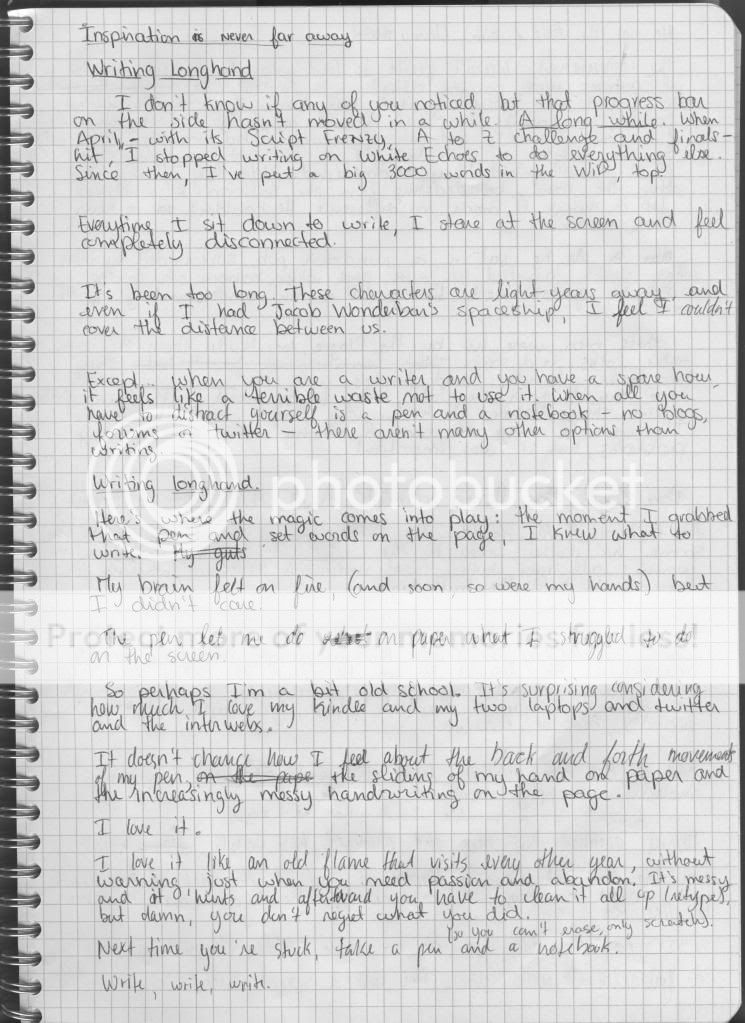
It took me exactly one page, which is nifty for scanning. So there you go, that's yesterday's post in all its handwritten glory. (ha!)
As usual, for a real and constructive post (I try), you can head at Wicked & Tricksy!
Back to writing with me. Look at the bar: I managed to get past 42,000 words. Progress!
Wednesday, May 25, 2011
Writing Longhand

 photo credit: gregwake
I don't know if any of you noticed, but that progress bar on the side hasn't moved in a while. A long while. When April - with its Script Frenzy, A to Z Challenge and finals - rolled around, I stopped writing White Echoes to do everything else. Since then, I've only put a big 3000 words on the WIP, top.
Every time I sit down to write, I stare at the screen and feel completely disconnected.
It's been too long. These characters are light-years away, and even if I had Jacob Wonderbar's spaceship, I feel I couldn't cover the distance between us.
Except... as a writer, I always feel it's a terrible waste not to use a spare hour. When all I have to distract myself is a pen and a notebook - no blogs, no forums, no twitter - there aren't many other options than writing.
Writing longhand.
Here's where the magic comes into play: the moment I grabbed that pen and set the words on the page, I knew what to write.
My brain felt on fire (and soon, so did my hands) but I didn't care.
The pen let me do on paper what I struggled to do on the screen.
So perhaps I'm a bit old school. It's surprising, considering how much I love my Kindle and my two laptops and twitter and the interwebs. It doesn't change how I feel about the back and forth movement of my pen, the sliding of my hand on paper and the increasingly messy handwriting on the page, as the story takes over and I can't write quite fast enough to keep up with my thoughts.
I love it.
I love it like an old flame that visits every other year, without warning, just when you need passion and abandon. It's messy and it hurts and afterward you have to clean it all up (retype) but damn, you don't regret what you did.
I'm getting carried away here. The point is, the next time you are stuck, take a pen (so you can't erase, only scratch off) and an empty notebook. Set the pen down on the blank page. Move your hand to form letters.
Write!
*****
Announcement: For the NaNoWriMo participants among you, today is the Office of Letters and Light's Summer Donation Drive. This drive will serve to pay Camp NaNoWriMo (which provides encouragements and wordcount progress tools any time of the year) and the NaNoWriMo website's servers (as in, move them elsewhere so they don't crash in 2011).
There are cool prizes for those who donate -- exclusive posters, bumper stickers, etc. -- and you can check the details for Camp NaNo here, see the poster/sticker here, or donate at the store. The store will tell you what you can get, depending on how much you donate.
Now I really want November to come back. Talking about NaNo does that to me.
Friday, May 20, 2011
Racking Tips

It's been two weeks now since I started my internship, and the experiments I'm running allows for a lot of downtime.
If any of you have watched TV shows with *real* (hahahaha) science such as, let's say, CSI*, you've probably seen scientists put pipettes in the plastic little buggers in that picture (or any bigger, more colourful variant of these).
These are plastic tips. To the great dismay of scientists worldwide, they don't come with the box. You have to put all 96 plastic tips in the rack and then sterilise them before you can use them.
The kind of mindless, menial task nobody wants to do.
What does this have to do with writing? Well, your mind might have lit up at the word menial or mindless. Not that writing is either. It's been said before, however, that such tasks are great for writing.
I'm not sure what about the small, repetitive physical tasks frees the mind to go elsewhere, but it works wonders. Your imagination shifts into high gears and speeds away, running down new paths.
The folks at my lab don't understand why I love racking tips so much. If they saw how much I've managed to unravel and decide about one of my writing project, though, they would.
Try it next time you're stuck! Find some dishes to wash, a room to clean or clothes to fold, and you might find your writer's block isn't as big as you thought!
*It should be said that I watch and like CSI. It's okay if they take a hour to do something that might require 3-4 days. I don't mind. It's fun nonetheless.
Tuesday, May 17, 2011
The Novel Love List
Often when I have to make a gut-wrenching decision about my story, I get a wee bit depressed. Killing a darling has a nasty side-effect: it makes you question everything else in the story.
I mean, if that scene you absolutely love wasn't any good, what about everything else you hold dear? Should it be trashed, too?
Of course not.
As a side note, I should say I believe killing your darlings isn't as much about removing all you hold dear as it is about taking out what has no place in the novel, whether you love it or not.
Now, back to the business at hand. Don't trash everything you love in a story. You'll hate what's left, and won't have any reason left to write it. No, after a good ol' darling-killing, there's only one thing you can do.
This little exercise is much like a pat on the back, but sometimes it's essential to remind ourselves why we write these stories and keep the flame alive.
Yes, your early love might not have its place in the story anymore. That doesn't mean the entire novel is worthless.
Look at it again. Love it. Write it.
I mean, if that scene you absolutely love wasn't any good, what about everything else you hold dear? Should it be trashed, too?
Of course not.
As a side note, I should say I believe killing your darlings isn't as much about removing all you hold dear as it is about taking out what has no place in the novel, whether you love it or not.
Now, back to the business at hand. Don't trash everything you love in a story. You'll hate what's left, and won't have any reason left to write it. No, after a good ol' darling-killing, there's only one thing you can do.
A Novel Love List
It's simple. You list everything you love about your novel in bullet form. You can do this whenever you feel your story drags, when you're no longer excited to sit at your keyboard and work on it. When you think it's all a pile of crap, and nobody will want to read it.
Remind yourself why you would read it, first. Go back to what enticed you to write it.
Here's my White Echoes novel love list!
- Hot air balloons. Aircrafts
- Genetic engineer bad guy
- Character with argyria
- Propaganda!
- Captain Vermen. Andeal. Seriously, I'd write it for these two guys.
- Fireworks at the end. Literally!
- Green-glowing roof
- Virus and bacteria gone wrong. Scary as shit.
- Hot air balloon. Oh, wait. Said that already.
- Conspiracy. Manipulative jerks. Crowd control. FUN times.
This little exercise is much like a pat on the back, but sometimes it's essential to remind ourselves why we write these stories and keep the flame alive.
Yes, your early love might not have its place in the story anymore. That doesn't mean the entire novel is worthless.
Look at it again. Love it. Write it.
Monday, May 16, 2011
The Burden of First Ideas
 |
| photo credit: MichaelConCarne |
Powerful ideas smashing the door to our brain and forcing their way in.
Not that we complain. We love those. It means our creative mind is travelling at full speed and producing its best juice. It's exhilarating. Wild. The first step in a new world.
Our first step into a new world.
So often we want to make it part of the story. This moment caught our attention and hooked us into a story. They have to be good, right? Readers will love them.
Sometimes, though - not always - this isn't for the best. Sometimes you take a scene and work out who the people in it are, and why there's a man holding a gun to another's forehead, and why he's incapable of shooting, and as you build your story from the scene, you get new ideas.
Context, plot, structure, characters, themes... everything changes. You plan, plot, write, brainstorm. You search for the real story, and the more you do, the further you get from your first love. Before you realise it, you're on the third draft and the first powerful moment, the very inspiration for this story, well, it doesn't fit anymore.
This is hard. It's hard to look objectively at your first creative impulse and admit it no longer has its place in this story. Kill your darlings, they say. The hardest part is to admit it has gone from a great, tension-filled, epic moment to a purposeless darling.
It must be done, however. Don't let your first ideas drag your story back. If you're not sure about a scene, or a character, or a plot twist... try to consider it objectively.
What does it bring to the story? What is its mission? Is it essential, or is it a leftover from your first drafts in this universe? If you remove it, what is the difference?
(Also, keep in mind that sometimes it is only part of a scene or character that should be shot down. This is what I had to do)
Be truthful with yourself. If you have a darling on your hand, it is your duty to the story to take your shotgun out, charge it... and shoot.
It's for its own good.
Tuesday, April 26, 2011
V - Vocabulary
(Fun fact: V day is also my Virology exam day. Wish me luck!)
Every writer knows the importance of choosing the right word. We're required to express ourselves clearly and concisely. Talking loudly is yelling. Hitting furiously is smashing. The right word will lighten your text and ease any reader’s experience. It will give your sentences punch and create vivid images. The right word is a writer's best friend.
What if you don't know enough words? How does a writer pick the right word if he doesn't know it exists?
This is one of my biggest problems. In day-to-day writing such as this blog, I get along just fine. I'm almost undistinguishable from a native English speaker (of course if I did vlogs it'd be another story. You guys could poke fun at my accent).
Novels require more, however, and to me this seems even truer with fantasy and science-fiction. Sound too much like a modern-day speaker and you'll lose the feeling of a different world. This little step above the norm may not seem like much, but it becomes a real challenge for me.
I know the meaning to a lot of words. No problems when I read. When I write, however, those words aren't the ones that come to my mind. I'll use the same adjectives, verbs and clothes names over and over in a first draft (the truth is that my clothing and food vocabulary is horrible. No kidding, it’s hilarious how often I have to look up basic clothing names!).
Learning new vocabulary means using it over and over, until it becomes natural. Not an easy task.
I must love challenges, because I never paused to think about this. I noticed it as I began reading again, and noticed the difference. It’s a good thing I have revisions and thesaurus. The second one is a great friend, if you know enough to avoid the wrong-synonym pitfall.
And I’m sure, deep down, that this problem isn’t limited to me. Perhaps it’s more frequent. I’d bet there are a lot of writers out there who get annoyed or stumped because this famous right word is escaping them, slipping through their fingers.
So, I say, no good reasons not to improve my vocabulary. After all, who wouldn't want to learn new words? Words are fun!
Saturday, April 23, 2011
T - Tenses
I write almost exclusively in third person, past tense. It is something that comes naturally to me, and my preferred tense when I read. Not that I'd avoid a book written in first person. Of course not.
What I noticed reading (and finishing, despite all the exams and other important things to do) Guy Gavriel Kay's Lord of Emperors this morning (and afternoon) was that while he did write in past tense, he sometimes switched to present.
He did this in A Song for Arbonne, too. It happened when events took place in Gorhaut, the northern kingdom that threatened a destructive war. I heard Kay state in an interview he had used present tense to convey a sense of urgency. An immediate threat.
It worked.
Obviously, the writer in me had to analyse why he was using past tense in this case. It wasn't impeding danger. The characters whose scenes were in present tense weren't villains. They were, however, the Emperor and Empress, and their thoughts and decisions shaped the world around them.
I have a feeling that's why -- present tense as a way to convey the importance of all they did.
I don't know if this is true. I haven't heard Kay say anything about this in an interview. Whether that was the intended effect or not, I think it's a neat trick.
I'm not sure I would've picked it up on it before I started.
What I noticed reading (and finishing, despite all the exams and other important things to do) Guy Gavriel Kay's Lord of Emperors this morning (and afternoon) was that while he did write in past tense, he sometimes switched to present.
He did this in A Song for Arbonne, too. It happened when events took place in Gorhaut, the northern kingdom that threatened a destructive war. I heard Kay state in an interview he had used present tense to convey a sense of urgency. An immediate threat.
It worked.
Obviously, the writer in me had to analyse why he was using past tense in this case. It wasn't impeding danger. The characters whose scenes were in present tense weren't villains. They were, however, the Emperor and Empress, and their thoughts and decisions shaped the world around them.
I have a feeling that's why -- present tense as a way to convey the importance of all they did.
I don't know if this is true. I haven't heard Kay say anything about this in an interview. Whether that was the intended effect or not, I think it's a neat trick.
I'm not sure I would've picked it up on it before I started.
Thursday, April 21, 2011
R - Reaching Out
If you've been around for a while, you know English isn't my first language. French is. I love French. It is beautiful, lyrical, impassionate. I become quite rant-y when it comes to defending it (which is, for the record, a big issue in Quebec).
Why, then, do I write in English?
Perhaps the hardest question I've ever been asked. It comes from strangers. It comes from friends. It comes from my mom, and that is perhaps the hardest to deal with.
After years of fumbling about, trying to come to terms with it, I think I have an answer. It is a simple one. All I needed was to look at why I write.
I write to reach out. I hope these novels, these characters, will one day touch someone's heart. That there'll be a reader emerging from my story with the feeling they're a little more human now, a little different.
If I hope to reach out one day, to as many as I can, I need English. I'm good with it. It's a wonderful and powerful tool to have. I'm not going to ditch it.
French is what I am. It defines me in more ways than I dare count. English is what I use. It might be a fine line, but to me it is an important one.
Why, then, do I write in English?
Perhaps the hardest question I've ever been asked. It comes from strangers. It comes from friends. It comes from my mom, and that is perhaps the hardest to deal with.
After years of fumbling about, trying to come to terms with it, I think I have an answer. It is a simple one. All I needed was to look at why I write.
I write to reach out. I hope these novels, these characters, will one day touch someone's heart. That there'll be a reader emerging from my story with the feeling they're a little more human now, a little different.
If I hope to reach out one day, to as many as I can, I need English. I'm good with it. It's a wonderful and powerful tool to have. I'm not going to ditch it.
French is what I am. It defines me in more ways than I dare count. English is what I use. It might be a fine line, but to me it is an important one.
Tuesday, April 19, 2011
Q - Querying: The Faraway Milestone
The Query. The one page that can make or break your career. The one page authors dread to write.
It seems to be that on the blogosphere, the query is the despised, necessary step toward traditional publishing. The querying process is described as an emotional rollercoaster during which you will need all the cheerleaders and supportive friends you can go.
Scary.
But honestly? I’m looking forward to it. I can’t wait to write my first query, to have it critiqued, revised, critiqued again and revised once more, before I send it to the wild, dangerous world of literary agents. My guts clench at the idea. My head says I must be crazy to want this. But my heart? It’s clamouring for this milestone.
A querying writer has a finished MS. She has gone through half a dozen drafts, through months (or years) of polishing. A querying writer stuck to her story through the whole process. Writing, editing, rewriting, replanning, letting it cool, editing again, polishing. Endless hours of hard work.
Only when they are done can the query be perfected. Sending a query means moving on. Taking the next step. Asking someone to seriously consider publishing you.
My first query might be years away. It’s a faraway milestone still, a distant dream I hope to achieve. It promises pain, fear, false hopes and many horrible things.
But my glass is always half-full, and beyond all these things, the query is a step to success.
So, I say, long live the query! May mine one day find the crammed inbox of dozens of agents, and perhaps touches one of their hearts.
Subscribe to:
Posts (Atom)