Showing posts with label inspiration. Show all posts

Tuesday, August 23, 2011

The First Spark

Every now and then, a blogfest comes about with a concept so cool - or so close to you - that you just can't resist. The Sparkfest is such a thing for me. Every time I look back at why and how I started writing, I am amazed.


There are three prompts for this blogfest, all of which I'm semi-ignoring. It's the question on the bomb I want to answer.

Who set you off? 

My ex-boyfriend.

I've always maintained that you can learn and grow from every relationship. Well, my ex brought me to writing. There's no denying it. Without him, I'd have never tried a full-length novel. I would've stayed with short scenes related to roleplaying games, tied to each other with little structure. They were a blast to write, mind you, but they weren't novels.

They were for me and him, until the day he said they were really good. Not just fun. Good, writing-wise.

I don't know if he said it because it was true, or because we were, y'know, dating, but it doesn't matter.

It was the boost of confidence I needed to jump feet first into the adventure. It helped that I found NaNoWriMo just as I got my first novel idea, and that I managed to get to the end. It also helped that, just when I felt there had to be more to this writing-thing, I found Nathan Bransford and the Bransforums.

The very first spark, however, the one that set off the whole process, came from my ex-boyfriend. Some days I wonder if he'll ever know the wildfire he started.

So tell me, who set you off?

Tuesday, August 2, 2011

Juggling With Projects - How Much of A Multitasking Writer Are You?

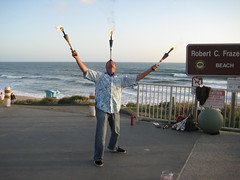
Juggler at the Beach


Before I started writing, I couldn't imagine a writer working on more than one story at a time. While I had no idea of the actual scope of efforts and time writing demanded, I knew it was at least "a lot", and it didn't possible to stretch one's mind on two or three projects at once.

Fast-forward a few years later. I started roleplaying and realised I could hold more than one story in my head at once. It still wasn't writing, but I think life was trying to prepare me for the truth.

Today I alternate between six different WIPs. I tend give most of my writing time to one of them during a few months, with the occasional dabbling in another. Then the first is put on the backburner, the second becomes the main project, and a third takes the dabbler's place.*

I know, however, that not all writers work like this. The number of WIPs one consistently works with is like most other variables of the writers' journey: they vary from one person to the other.

So I'm curious, writer friends! How many WIPs do you work with? If you've got more than one, how do you usually function?

*Trying to pick the next dabbler is always tons of fun... in a very *head desk* I don't know which I prefer right now, aaaah!

Monday, June 20, 2011

The Downhill Slope

I love writing endings.

Planning them is a tough cookie. You have to make sure all the parts fit, and that they carry enough significance and strength. It needs to be tense and heartwrenching and all kinds of other hard things. Fitting the pieces correctly plays a big role in this, and that's one thing I do through planning.

The rest comes with good writing. Conveying all the powerful emotions with the right words and the right actions.

Here's the thing. I like my ending's plan. When I talk about it, I get carried away and excited like no other part of the novel. When I put it down? It comes out all wrong, of course.

I'm not worried, not even for a moment. NaNoWriMo has taught me to ignore the lame writing and keep moving forward. As long as I am confident that I am writing the right scene, I don't mind the lameness level of what is inside.

I just want it there. I need something to work with later and I need a first feel of how these imagined scenes play out. There's no editing a blank page, and all that.

Last week, I hit this point in the novel where everything goes downhill. I know exactly what goes where, and when, though it was a real headache to puzzle it out. Now that's behind me. All I have to do is write, write, write.

Slide down the hill until I reach the finish line.

The End!

Thursday, June 9, 2011

Science, Fiction & Truth

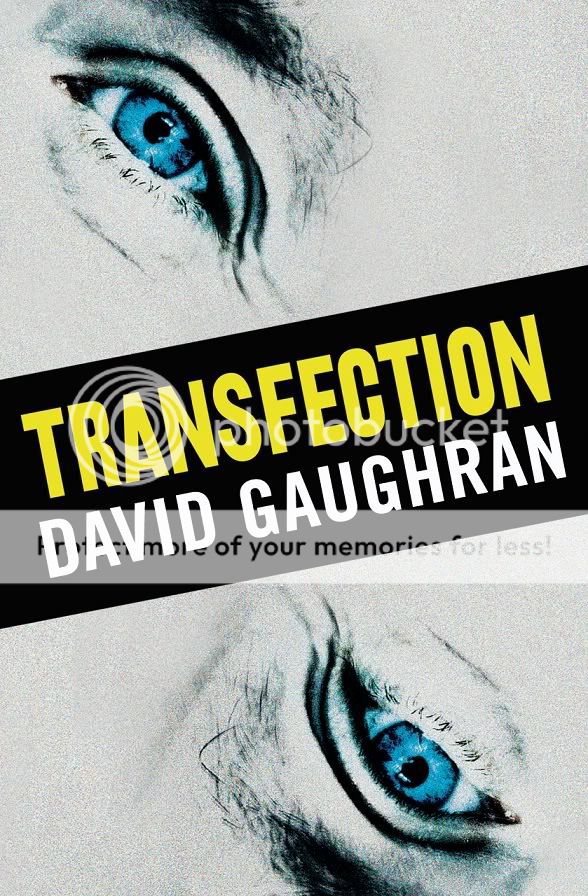
This is a special Thursday, everyone! I am having my first guest post and my first giveaway, all at once! Please welcome David Gaughran, author of If You Go Into the Woods and Transfection (I expect clapping, folks). On a normal weekday, you can find him on his super-helpful blog Let's Get Digital, Digital.

EDIT: Forgot to say, I'm on Wicked & Tricksy as usual. It's Villainy Week!

***
My science fiction tastes have always been very compartmentalized. Space operas must be TV shows. I’m not convinced they work as well as movies, let alone books. Anything to do with robots, I prefer as a movie. I want to see the robot, and only movies have the budget to make it look really cool.

I’m a little more democratic when it comes to books. A good story will trump all, but I do gravitate towards near-future dystopia. Spaceships and aliens and all that are okay, but I would rather have a story about a man who struggles to form relationships because he can read minds, or about a cloning experiment gone wrong. For me, the further the story is away from the real world, the less it says about it in a clever way.

This latter qualification is important to me. Sure, you can have a version of Romeo & Juliet set on an interplanetary cruiser, or have an alien encounter story that teaches us about racism, but I prefer my messages a little more subtly coded. I don’t like neon signs telling me what to think.

Philip K. Dick is a favourite. Do Androids Dream of Electric Sheep was great, but I liked Flow My Tears, The Policeman Said even more. He was a master of creating this sense of unease in the reader, which perfectly mapped what the character was feeling.

In many of his stories, it takes a while to figure out if this is taking place on our world or not, or whether it is set in the future or not, or whether the main character is crazy or not. That sense of dislocation is a brave move for a writer. So many feel compelled to do their world-building right from the start, with unwieldy explanations of various technological advances or geographical quirks that signify to the reader, right from the off, that you are somewhere else.

Instead, Dick deliberately keeps that from you, and the overall effect is very disturbing. You really get under the characters skin, and start seeing this strange world through their eyes, and begin questioning yourself, just like the character does.

I call that old-school science fiction. We used to have a lot more of it before Star Trek, the comic-book movie explosion of the 80s, and the alien boom of the 90s. I’m talking about guys like Ray Bradbury, movies like Soylent Green, and shows like The Twilight Zone – where there was more of an emphasis on the science than the fiction.

I think the distinction comes from the genesis of the story and the priorities of the writer. In the space operas and alien splatter-fests, I think the idea of “world” comes first and story second, whereas in old-school science fiction, the story always comes first.

My favourite kind are “what if” stories – which Hollywood likes to call “high concept” stories – and science provides fertile ground here. What if no-one ever became pregnant again (Children of Men)? What if we lived in a society so controlled that even thought was a crime (1984)?

The first half of the 20th century was a period of such massive technological change – cars, airships, televisions, airplanes, tanks, nuclear bombs - that there was this feeling that science could accomplish anything.

But there was also an undercurrent of fear. Scientists were often depicted as weak, amoral people who could be easily co-opted by nefarious governments and corporations.

Maybe I’m just reading the wrong stuff, but I think we have lost some of that from science fiction today. It’s a pity, because science is providing is with just as much material as before: cloning, cryogenics, nanobots, in vitro meat – there is so much great stuff there.

I wanted to write a story with that old-school vibe. Like most of my short story ideas, it came from a conversation with a friend over a few beers. We were talking about genetically modified food, and some of the fears out there, and whether they had any basis.

Then, as the night went on, we started going in ridiculous tangents about tampering with organisms at the most fundamental level, and what potential side-effects there could be that we haven’t even considered.

I remembered the story of the Radium Girls.  They were a group of factory workers in New Jersey during World War I, whose job was to paint watches with glow-in-the-dark paint for the military.

They were told the paint was harmless and were instructed to lick the paintbrushes to keep them pointed. The girls often painted their nails and teeth for fun.

The paint, of course, was radium-based, and the girls’ continued exposure led to radiation poisoning. The company attempted to smear these women, and claim their symptoms were caused by syphilis, and medical records were withheld by doctors and dentists to aid in the cover up.

It is still unknown how many Radium Girls died.

The point is that science and truth don’t always go hand in hand, not when there is money involved. It’s in these cracks that stories are born, and I think science fiction is uniquely placed to share them with the world.

Transfection, an old-school science fiction short, is available from Amazon and Smashwords for 99c.
*** 
That story about the Radium Girls gave me shivers. It goes on the list of scary science things from Sommer's post this Monday.


Now, about the contest. I am giving away five copies of Transfection*, because it is awesome and creepy, and I think you should all read it.


All you have to do is to answer this question: "What area of science do you find creepy?"

You can do so here in the comments, or on twitter. If you use twitter, tag it with #creepyscience so I can see it (and feel free to link to this post if you have room)! I'm giving four copies to the comments, and one to the twitter participants. So, yes, you can technically enter twice!

The answer can be a whole area of study, an anecdote (such as the radium girls) or, well, pretty much anything science-related that creeps you out. Go wild!

You have until Wednesday June 15th, 11:59 PM EST to answer. I'll announce the winners next Thursday!

*If you don't own an e-reader, you can always read e-books from your smartphone, iPad or laptops with this free amazon app.

Sunday, June 5, 2011

The Idea Worm

Something happened to me this weekend that I bet happens to every writer. It's both exciting and irritating. I'm not sure yet. I haven't decided.

It started on Friday with a simple thought. The possibility of a new scene, not in the outline. You know... "It'd be really cool to have a scene where X, Y or Z happened."

You tell yourself there isn't room for this scene in the story. It doesn't work with the greater storyarcs - heck, it doesn't work with the subplots either. Except... well, there is that one place, you know, where it'd fit?

Not quite, though. So you put this cool scene aside and stick to your earlier guns. Let's not derail the whole plot for one epic action scene, right?

The problem is that as time passes by, you can't help but think back of this scene. You list what needs to be changed for it to work. You mentally smoothen transitions from this scene to others, and all the build-up around it.

It'd be a lot of work, changing it. Too much for what it's worth? This is where it starts to get messy. This new scene has consequences on the entire outline. Changing it will require a good deal of rewrite, and replanning the end before you get there. You ask yourself if you should. If it really makes your book better.

You list all the ways in which it does. More tension. Bigger stakes and obstacles. A whole new world of dangers and complications added, both at the scene and for the climax.

The writer in you sees the potential. The human being recalls the hours of plotting and the pain of yet another rewriting.

Tough choice.

Except... we all know it's not really one, right? Once I find a way to make my story better, there's no way I can abandon it.

That's where I stand right now. I'll have to rework the ending and rewrite quite a number of scenes. Perhaps add a POV and cut another one. Right now I'm not sure if I have a handle on this story anymore. All I know is, my brain is fried from thinking through all the possibilities over and over...

At least I still have one scene to write where this whole new storyline branch doesn't change much. Gives me a bit more time.

Does this ever happen to you? How do you deal with it?

Tuesday, February 8, 2011

The Epiphany

I know I had a more serious post planned for today. Something about the nuts and bolts of writing. For the life of me, though, I can't remember what the topic was. It'll come back when my brain settles.

But what puts you in such a state, you ask?  (well, maybe not, and besides it's in the title, but I'll act as though I hadn't noticed).


Yesterday as I walked to class, I had a writing epiphany.

Not on WHITE ECHOES. It's another story, one I have carried with me for longer than I even write novels. All I had was a character, born from a short-lived game of roleplaying. I created tons of RP characters in my years, and they all tend to vanish.

Not this one.

For six years he waited in my head. Once, I tried writing his story. I blocked after 4000 words. I had no idea where this was going. I did not like what he was becoming. Every few hundred words, he also said or thought something horrible. Fezim is as twisted, disgusting and complex a character as I've ever done, but he happens to be charming and funny. It is so hard to balance the two. Especially when you have no idea where this is all going. In a way, I didn't feel safe with him 'in control' of the storyline.

But it's over now! With a 30-minute walk under big snowflakes, chatting up with friends, I somehow saw the ending. Within two hours I had drafted three scenes, including the last one and now my mind is bubbling with subplots and main characters.

This is going to be fun.

I do need to remember, however, to finish WHITE ECHOES' draft before I give in entirely to the Shiny New (well, somewhat new) Idea.

Isn't it fun when this happens? How do you guys deal with the new ideas? I normally just jot them down and move on. Any other tricks?

Sunday, January 9, 2011

The Benefit of a Small Walk

We're well into January by now, and I have not started writing the new draft yet. Life got in the way, as is usually the case when my schedule is buggered. I'm not complaining. Not everything that gets in the way of writing is bad.

It remains that in the last ten days, I've made almost no progress on my brand new outline. I was stuck with 75% of the novel, which is to say I had every major plot points outlined, but was quite fuzzy on how I brought them together into a single, solid climax. They converged, yes, but it was loose and unsatisfying.

No longer! Half-hour of walking, and all my problems were solved. I feel silly for not doing it earlier, as I've solved countless plotholes in the twenty minutes I need to reach my University from home.

So remember the next time you're stuck: take a walk. Let your mind wander alongside your feet, and see where it leads you.

Thursday, January 6, 2011

Unblocking Your Outline

Often when I plan, I get shiny new ideas to make my storyline better. Ideas such as "What if X met Y?" I love 'What if ...' and usually, I'm able to determine the circumstances in which the 'What if' would happen.

That's when I get blocked.

Not all the time, but it happens often enough that I've developped a way to get me out of it. It's not complicated. I just write the scene.

Most of the time I put next to no description, and very little actions. I'm a dialogue person, and since they are usually what moves my story forward, they are what I focus on. The goal is to get a rough scene out, to write in circle until I find out where this is supposed to go. My mind does it for most of the novel, but when I get stuck, I need to write things down to get somewhere.

In a way, this is a lot like what I do with my first drafts. I'm testing the grounds. I just let the creative juice out, knowing this will never make it into the novel. It's a great way to work out my storyline.

Hopefully it will get me past my current knot. I'm almost done replanning!

Saturday, December 18, 2010

The Little Sparks of Inspiration

I believe my brain understood school was officially over yesterday morning. My first day off.

I was sitting at my kitchen table, looking out at the heavy, fuzzy snowfakles that fell from the sky. It was quiet and pretty, and I had a warm cup of coffee. No stress. Everything you want from a first vacation morning.

I picked up the newspaper, finally able to sit down and read them properly. It's one of those little things I cut into when I need to find more time, but after a month and a half of running around, I was glad to open my morning read (remember, there was NaNo just before, too). A white enveloppe fell from it.

I knew what was in that enveloppe. I knew it'd be that little card reminding me that I had a loyal paperboy, getting up early every morning to deliver my newspaper, and that he was the reason I could finally enjoy it once more. And yet, I felt that little twinge of excitation, as though that random white enveloppe contained a small treasure.

In the end, I was right. It was the Christmas card reminding me that giving tip to the paperboy would be the gracious thing to do, but it was more than that, too.

The wording of the reminder - about the paperboy coming to my door every day - sparked a scene in my head, and from that scene I imagined two characters, and within a minute of reading the text, I had a short story. Sure, the paperboy in it wishes I didn't, but I was thrilled!

In the end I never read most of the newspaper. I was too busy scribbling notes in my large notebook, on the verge of squealing, happy with myself and where this little story was going. There's very little that is more enjoyable than the first spark, the rush of ideas and adrenaline that comes with it.

And boy, I was glad to have a notebook within reach!

Thursday, December 16, 2010

The Magic of my Brain

Finals are a rough time. They demand a lot of energy, and all the concentration your brain can muster. One would think that, under such conditions, there wouldn't be a lot of room for writing.

One would be wrong, too.

I discovered something amazing these past four days. Even when I am insanely busy, when I have a billion things to think about, my brain continues to work on my story. It nags at the knots in my plot and looks around for filler to put in the plot holes, never quite pausing, and never quite consciously.

And when I walk those 20 minutes that get me to the University, the brain goes loose. Twenty minutes to tell me everything he's found out! QUIIIICK. 

I've never felt as inspired as during those short walks, to and from my University. Every time, there's a new discovery! It's fantastic. It makes staying away harder, too.

But now, well, I am done at last, and I can finally put down all those notes and changes I've thought about in the last days, and deepen them to make sure they fit with the story. I can go back to my plan, and use it. I can write!

Truly, this is a happy day. Thank you, Brain.

Wednesday, October 20, 2010

Inspiration - The Initial Idea

I find it funny how when I decided to write my first novel, my family wasn't surprised. They just looked at me and went "Oh? That's nice. Good luck!" No questions. They could easily guess it was fantasy, and I did not leave time for more before I explained what NaNoWriMo was.

Now that I am working on my 4th and 5th story, however, I think they are beginning to understand I did not only have this one idea, shimmering under the surface, waiting to be told. I had many, and they kept coming.

This led to one question, which I am sure you've all heard: Where do you get all your ideas?

In my case, what happens most of the time is that I will notice a detail and linger on it, wondering what would happen if it became central to a story, or if I changed it. Sometimes I combine two of these. A few examples:

1.  I wondered what would happen with a fantasy world in which magic did not appear with puberty. I chose to have it come with age (or infertility). From there I built a world, and from this world my current plot emerged. I struggled with it on quite a few occasions, and today the 'old magic' is a background element, but that's where it all started.

2. I read two novels recently in which there are a fair amount of vineyards in the world. It's never an important element, but a little voice in my mind says it would be cool if it was. It's on my list of Things to Write Someday.

3. I was watching something about hot air balloons on TV while listening to A Criminal Mind. My mind jumped from one to the other, and thought it would be cool if a balloon driver unknowingly took a criminal on board. This was the very beginning of White Echoes.

Anything can spark my initial ideas. It's more frequent when I read, but it has happened with music and TV and dreams. I grab passing thoughts and force them to stay, until I see their potential for an unique story element.

How about you? Where do you get ideas?